
Published On: 21 August 2026
False eyelashes can instantly change the way your eyes look—but are the extra length, volume, and flexibility worth the effort that comes with them?
This guide breaks down the real benefits and disadvantages of wearing false eyelashes so you can decide whether they fit your makeup routine.
You’ll learn how falsies can add definition, offer different styles, provide a removable alternative to extensions, and improve value when reusable.
We’ll also cover the downsides, including repeated application, fit and comfort issues, adhesive irritation, cleaning and maintenance, lifting during wear, and the risk of pulling natural lashes during rough removal.
You’ll also see who may benefit most, who should be more cautious, and whether false eyelashes are worth it overall for you.
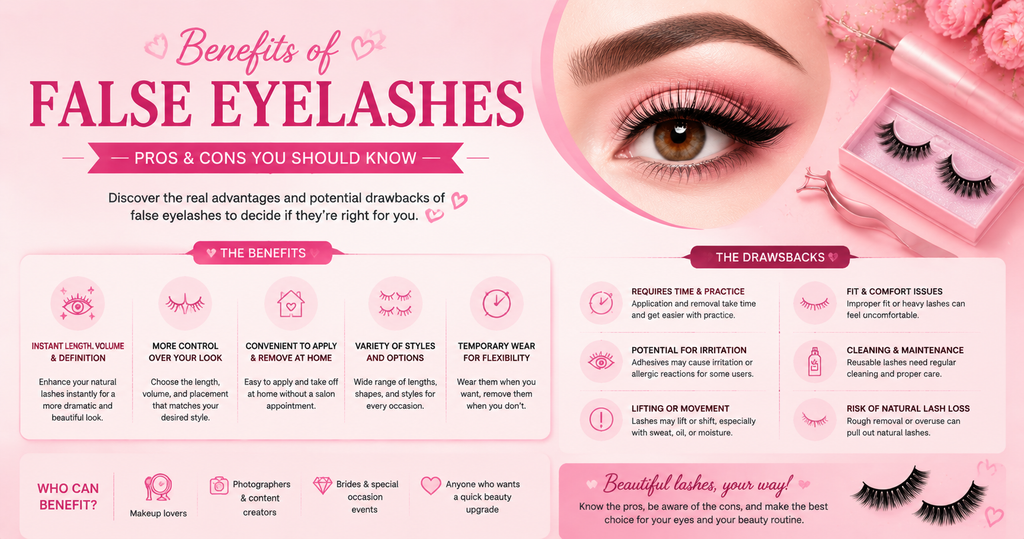
Benefits of Wearing False Eyelashes
1. Add Instant Length, Volume, and Definition
False eyelashes give you an immediate way to make your lash line look longer, fuller, and more defined by adding extra fibers beyond the length and density of your natural lashes.
Artificial lashes have long been used specifically to enhance eyelash appearance, while longer and fuller lashes are recognized as common aesthetic goals in eyelash cosmetics.
If your natural lashes look fine, short, or sparse, choosing an appropriately sized false-lash style can create visible fullness and make the upper lash line appear more prominent without requiring several coats of mascara.
The effect is cosmetic and appears as soon as the lashes are applied correctly; false eyelashes do not stimulate or accelerate natural eyelash growth, so the added length and volume last only while the falsies are being worn.
2. Give You More Control Over Your Lash Look
False eyelashes give you more control over both the intensity and placement of your lash enhancement.
Full strips can create broader definition across the lash line, while half lashes can concentrate length and volume toward the outer corners for a softer, more lifted effect.
Individual or cluster lashes offer even more precise placement because you can choose different lengths and add fullness only where you want it.
Current reusable lash systems are available as full strips, half lashes, individual lashes, and clusters in multiple lengths, making it possible to create anything from subtle everyday definition to a fuller, more dramatic look.
You can also vary placement—for example, concentrating lashes toward the center for a rounder, doll-like effect or toward the outer corner for a more elongated look.
3. Convenience: Apply and Remove Them at Home
Traditional false eyelashes give you the convenience of creating a fuller lash look at home without booking a salon appointment. Standard strip lashes can be fitted, trimmed if necessary, coated with lash adhesive, and positioned along the lash line using a relatively short DIY application process.
Official strip-lash instructions commonly follow this basic sequence, while removal can be done by first softening the adhesive with a compatible makeup remover and then easing the lash away gently.
Because removable falsies are not permanently attached, you can take them off when the look is no longer needed and choose a different style for another day or occasion.
The process may feel less convenient at first, however, because accurate placement and adhesive control usually become easier with practice.
Read Here: how to apply false eyelashes
Read Here: how to remove false eyelashes
4. Variety: Choose From Different Lengths, Shapes, and Styles
False eyelashes are available in a wide range of lengths, volumes, shapes, and application formats, allowing you to match the lashes to both your makeup style and the visual effect you want around your eyes.
Current lash collections include natural, wispy, cat-eye, dramatic, individual, underlash, cluster, and full-strip options, while strip lengths can range from short, subtle styles to considerably longer designs.
A softer, lower-density lash can add understated everyday definition, whereas layered or fuller fibers can create stronger volume for glam makeup.
You can also choose a lash pattern that concentrates length toward the outer corner, distributes volume across the entire lash line, or uses individual clusters for more targeted placement, making false lashes adaptable to different eye shapes, occasions, and desired finishes.
Read Here: Styles of False Eyelashes
5. Temporary Wear Gives You More Flexibility
Removable false eyelashes give you more flexibility because you are not committed to the same lash style for weeks at a time.
You can wear a lightweight, natural-looking pair for everyday makeup, choose fuller lashes for an event, or skip falsies completely on days when you prefer your natural lashes.
Traditional strip lashes are designed for temporary wear, with some current products providing hold for up to a day before removal rather than remaining attached through an extended lash-growth cycle.
This temporary format also lets you experiment with different lengths, densities, and shapes without making a longer-term style commitment.
If one look no longer suits your makeup or occasion, you can remove the lashes properly and choose a different style the next time you wear them.
6. Affordability: Lower Initial Commitment Than Professional Extensions
Traditional false eyelashes generally require a lower upfront financial commitment than professionally applied eyelash extensions, because you purchase the lashes and adhesive for at-home use rather than paying for a salon application service.
Current retail strip-lash options can cost only a few dollars per pair or be sold in affordable multipacks, whereas professional extension services can involve a substantially higher full-set price plus ongoing refill appointments.
Extension maintenance can also require regular refill visits as natural lashes shed and new growth appears, adding recurring service costs for people who want to maintain a consistently full look.
False lashes are not automatically the cheaper option in every situation, however, because your total spending depends on the lash style, how frequently you wear them, whether they are reusable, and the cost of adhesive, remover, and replacements.
7. Reusable False Lashes Can Improve Cost Per Wear
Reusable false eyelashes can give you better value from each pair because the original purchase cost is spread across multiple applications instead of a single wear.
The exact number of reuses depends on the product: for example, some reusable strip lashes are designed for multiple wears with proper care, while certain pre-bonded cluster systems have much lower stated reuse limits.
To get the intended value, remove the lashes gently, clean away compatible adhesive and makeup residue, let them dry completely, and store them without bending the band or fibers.
Reuse should stop earlier if the lashes become damaged, misshapen, or difficult to clean safely, even when you have not reached the manufacturer’s suggested maximum.
Read Here: how do i clean false eyelashes for reuse
8. False Lashes Can Reduce the Amount of Mascara Needed for Some Looks
Because false eyelashes already add visible length, volume, and lash-line definition, you may not need several coats of mascara to achieve the same level of emphasis.
Full or layered falsies can supply much of the visual density themselves, while lighter styles may still benefit from a small amount of mascara on the natural lashes depending on the look you want.
Some lash systems are specifically designed to be worn without mascara at all; for example, certain underlash systems instruct users not to apply mascara before or after application.
Avoid assuming this rule applies to every false lash, however, because mascara compatibility depends on the particular lash system and its care instructions.
9. Useful for Everyday Makeup, Events, and Photography
False eyelashes can be adapted to different levels of makeup intensity, which makes them useful for everything from subtle everyday definition to more noticeable event or camera-ready looks.
Lightweight, lower-volume styles can create a softer effect suitable for everyday makeup, while fuller or layered designs provide stronger length and volume when you want the eyes to stand out more.
Current false-lash ranges specifically span natural, everyday and glam styles, with products designed from lightweight subtle enhancement through to high-volume dramatic effects.
Because removable lashes are temporary, you can choose a restrained style for work or daytime wear and switch to a fuller pair for weddings, parties, photographs, or other occasions where stronger eye definition suits the overall makeup.
Disadvantages of False Eyelashes
1. Temporary Wear Means Repeating the Application Process
The temporary nature of traditional removable false eyelashes means you must repeat the application process each time you want to wear them. A typical routine involves positioning the strip, applying adhesive, waiting for the glue to become tacky, securing the lash along the lash line, and then gently removing it after wear.
Reusable pairs also require old adhesive to be removed and the lashes to be cleaned and stored correctly before the next application.
Official false-lash care instructions similarly separate application, removal, adhesive cleanup, and storage into recurring steps between wears.
If you wear falsies frequently, this repeated routine can take more time and effort than a longer-wear lash option. However, the same temporary design also gives you the flexibility to stop wearing falsies or change styles whenever you want.
2. Applying False Eyelashes Can Be Difficult for Beginners
Applying false eyelashes can take practice, patience, and precise placement, especially when you are using strip lashes for the first time.
You may need to compare the strip with your natural lash line, trim excess length, apply an even layer of adhesive, wait until the glue becomes tacky, and then position both lashes close enough to the natural lash line that they look balanced.
Manufacturer application instructions follow this same sequence of checking the fit, trimming when needed, applying adhesive, allowing it to become tacky, and then securing the strip in position.
Beginners commonly struggle by applying the lash while the glue is still too wet, using too much adhesive, or repeatedly repositioning the strip, which can make the process messy and cause the corners to lift.
Following the adhesive’s stated waiting time and practicing placement before adding glue can make application more predictable over time.
3. Poor Fit Can Make False Eyelashes Uncomfortable
A false lash that does not fit your eye properly can feel noticeable, uneven, or irritating during wear, particularly when the strip extends beyond your natural lash line or is positioned poorly near an eye corner.
Measure the strip against your eye before applying adhesive and trim it only when the product instructions allow; manufacturers specifically include a fit check and trimming step before application because strip lashes are not automatically the correct length for every eye.
Placement matters as well: a lash that lifts at one end or sits away from the natural lash line may feel less secure, while thicker or heavier styles can be more noticeable than lightweight designs.
If a properly fitted lash still causes burning, persistent redness, swelling, or irritation, remove it and stop using the product rather than assuming the discomfort is simply part of wearing falsies.
4. Lash Adhesive Can Cause Irritation or an Allergic Reaction
Lash adhesive can cause irritation or an allergic reaction in some people because the glue is applied directly beside delicate eyelid skin.
Irritation and allergy are not identical: irritant contact dermatitis results primarily from direct chemical or physical injury that triggers inflammation, whereas allergic contact dermatitis is an immune-mediated reaction that develops after sensitization to a particular substance.
False-eyelash adhesives may contain ingredients capable of causing reactions in susceptible users; published case reports have documented allergic contact dermatitis from cyanoacrylate-containing false-eyelash glue, while the FDA has also received reports of allergic reactions involving cosmetics that commonly contain natural rubber latex, including eyelash adhesives.
This means redness, itching, burning, rash, or eyelid swelling may sometimes be related to the adhesive rather than the false-lash fibers themselves.
Stop using the product if significant irritation develops, and seek medical advice if symptoms persist or become severe, as recommended by the FDA.
5. Incorrect Removal Can Pull or Break Natural Lashes
Pulling false eyelashes off while the adhesive is still firmly attached can place unnecessary mechanical tension on your natural lashes, especially when some natural hairs have become caught in the glue.
Instead of ripping the strip away, soften the adhesive with a remover that is compatible with the lash system and gradually ease the band away while watching for natural lashes that move with it.
Mechanical traction is a recognized mechanism of natural-lash loss in ophthalmology literature on eyelash extensions, where persistent pulling can contribute to traction alopecia and, with continued stress, follicle damage.
The evidence is strongest for longer-wear extensions rather than occasional strip lashes, so it should not be interpreted to mean that properly used removable falsies automatically cause lash loss.
However, the same mechanical principle supports avoiding forceful removal: if your natural lashes are being tugged, stop, soften the remaining adhesive, and continue only when the false lash releases with minimal resistance.
6. Reusable False Lashes Require Cleaning and Maintenance
Reusable false eyelashes can save you from replacing a pair after every application, but that benefit comes with an extra care routine between wears.
After removal, you may need to clear dried adhesive from the band, remove compatible makeup buildup, allow the lashes to dry completely, and return them to a protective case without bending the fibers or strip.
You should also inspect the band and lash pattern before each reuse rather than assuming that a reusable label means the pair remains suitable indefinitely.
This maintenance takes additional time compared with simply discarding a single-use pair, and aggressive cleaning can shorten the lash’s usable life instead of extending it. If residue cannot be removed without stretching the band, pulling fibers, or using an unsuitable cleaner, replacing the pair is the better option.
7. Poor Hygiene Can Increase Eye-Area Contamination Risk
Reusable false eyelashes need careful hygiene because they are repeatedly handled and placed very close to the eyelids and natural lash line.
Wash and dry your hands before handling them, keep applicators and storage cases clean, and never share a worn pair with another person.
The FDA specifically warns against sharing eye cosmetics because contamination can pass between users and recommends discarding eye cosmetics that were being used when an eye infection developed.
Research on used eye cosmetics also confirms that microbial contamination can occur during normal use, particularly when products or applicators are shared.
Regular home cleaning can remove residue and reduce contamination, but it should not be described as sterilization; the CDC defines sterilization as a separate process that eliminates all forms of microbial life.
8. Glue, Makeup, and Repeated Cleaning Can Shorten Their Usable Life
Reusable false eyelashes do not last indefinitely because adhesive buildup, makeup residue, removal, and repeated cleaning gradually put wear on the band and fibers.
Old glue that is allowed to accumulate can make the band harder to clean, while mascara and other makeup can leave the fibers clumped and require additional handling.
Manufacturers therefore recommend removing residual adhesive, cleaning reusable lashes gently, and returning them to their tray between wears; they also note that the number of successful reuses varies with care.
The common mistake is trying to extend a pair’s lifespan by scraping stubborn glue, scrubbing coated fibers, or repeatedly reshaping a damaged band. Those aggressive methods can break fibers or bend the band, making the lashes unusable sooner.
Once a pair can no longer be cleaned without damaging its structure, replacing it is more practical than continuing to force additional wears.
9. False Lashes Can Lift or Shift During Wear
Temporary false eyelashes can lift at the inner or outer corner or move out of position when the strip is poorly fitted, the adhesive is applied incorrectly, or the lash is positioned before the glue reaches the proper tackiness.
Correct strip-lash application therefore starts by checking the fit and trimming excess band length when necessary, followed by a thin, even line of adhesive and the specified waiting period before pressing the strip close to the natural lash line.
Skipping these steps can leave sections of the band with weaker contact and make lifting more likely during wear.
Some modern strip-lash adhesives are water-resistant or marketed for extended hold, but that does not make every temporary lash permanently secure under every wear condition.
If a corner begins lifting, avoid repeatedly pressing a loose, poorly fitting strip back into place without addressing the fit or adhesive problem first.
Can False Eyelashes Damage Your Natural Lashes
False Lashes Do Not Automatically Damage Natural Lashes
Wearing removable false eyelashes does not automatically mean your natural lashes will become thin, weak, or fall out. The greater concern is how the falsies interact with your natural lashes during application and removal.
A correctly fitted strip should sit along the lash line without relying on your natural lashes to support excessive pulling force, and removal should occur only after the adhesive has loosened sufficiently.
False-lash adhesives can still irritate sensitive eyelid tissue, so redness, burning, swelling, or other persistent irritation should not be treated as a normal part of wearing falsies; the FDA recommends stopping an eye cosmetic immediately if it causes irritation and seeking medical advice if the irritation persists.
Rough False Lash Removal and Excessive Traction Can Damage Your Natural Lashes
Ripping false lashes off while adhesive is still gripping your natural lashes can create mechanical traction that pulls on the lash hairs and their follicles.
Ophthalmology guidance on longer-wear eyelash extensions recognizes traction alopecia as natural-lash loss caused by the pulling force exerted by artificial lashes, with prolonged traction potentially affecting the follicles themselves.
The strongest clinical evidence concerns extensions rather than occasional removable strip lashes, so it should not be interpreted as proof that ordinary falsies inevitably cause traction alopecia.
The practical mechanism is still relevant, however: if you see or feel your natural lashes moving as you remove the strip, stop pulling, soften the remaining adhesive with a compatible remover, and continue only when the false lash releases with minimal resistance.
Adhesive Choice and Proper False Removal Matter for Your Natural Lash Safety
Use a lash adhesive intended for the eye area and follow its application and removal directions, because both the adhesive chemistry and the force required to remove the bond can affect your experience.
The FDA specifically lists false eyelashes and eyelash adhesives as eye-makeup products and warns that reactions around delicate eyelid tissue can be particularly troublesome.
Apply only the amount of glue needed, avoid placing adhesive directly into the eye, and never compensate for an overly strong bond by pulling harder during removal. Instead, use a compatible remover to loosen the adhesive and ease the band away gradually.
If the glue repeatedly causes redness, burning, swelling, rash, or another unexpected reaction, discontinue that product rather than continuing to expose the eye area to it.
Are False Eyelashes Safe for Sensitive Eyes
Check the Adhesive Ingredients
Check the ingredient list of the lash adhesive as carefully as the false lashes themselves, because sensitivity may come from the glue rather than the lash fibers. Natural rubber latex is one possible allergen; the FDA has received reports of allergic reactions involving cosmetics that commonly contain latex, including eyelash adhesives.
However, choosing a “latex-free” adhesive does not guarantee that you cannot react to another ingredient.
A published case report documented allergic contact dermatitis from a cyanoacrylate-containing false-eyelash glue, demonstrating that non-latex adhesive ingredients can also trigger reactions in susceptible individuals.
Follow the product’s ingredient and safety information rather than relying on a single marketing claim such as “latex-free” as proof that an adhesive will suit every sensitive user.
Stop Wearing False Lashes if Irritation Develops
Remove the false lashes and stop using the associated eye cosmetic if you develop persistent redness, itching, burning, eyelid swelling, rash, or significant discomfort.
The FDA specifically advises stopping an eye cosmetic immediately when irritation occurs and consulting a doctor if the irritation persists.
Do not repeatedly reapply the same adhesive to see whether the reaction happens again, because continued exposure may prolong the problem if a product ingredient is responsible.
If symptoms include severe facial swelling, breathing difficulty, or another sign of a serious allergic reaction, seek urgent medical attention.
Avoid False Lashes During an Eye Infection or Active Eye Irritation
Do not apply false eyelashes while you have an eye infection or active inflammation around the eye area. Adding adhesive, manipulating the lash line, and using additional eye cosmetics can expose already irritated tissue to products it does not need while it is recovering.
The FDA recommends avoiding eye cosmetics when an eye infection is present or the surrounding skin is inflamed and waiting until the area has healed before resuming use.
It also recommends discarding eye cosmetics that were being used when the infection developed, so false lashes worn during that period should not be cleaned and saved for another application.
Who May Benefit Most From False Eyelashes
People Who Want an Immediate Lash Transformation
False eyelashes suit you well when you want a noticeable change in lash length, fullness, or definition as soon as your makeup is applied.
Full strips can add volume across the entire lash line, while clusters and other targeted styles let you build extra fullness where you want it most.
Current lash systems are specifically available in natural, wispy, voluminous, and dramatic designs, with different lengths that allow anything from a subtle enhancement to a more obvious transformation.
Unlike a lash-growth treatment, however, this transformation is purely cosmetic and lasts only while the false lashes are being worn.
People Who Like Changing Their Makeup Style Frequently
False lashes are particularly practical if you enjoy changing the intensity or shape of your eye makeup from one look to another.
You can choose softer, lower-volume lashes for minimal makeup, switch to fuller or longer fibers when you want more drama, or use clusters to concentrate volume in selected areas of the lash line.
Manufacturer ranges currently span natural, wispy, dense, dramatic, full-strip, half-lash, and cluster formats, giving you considerable control over the finished effect.
Because removable styles can be changed between applications, you are not locked into the same lash map every time you do your makeup.
People Who Prefer a Removable Alternative to Extensions
False eyelashes can be a good option if you want added lash volume without committing to a longer-wear professional extension set.
Traditional strips are applied when you want the effect and removed afterward, while newer removable clusters and pre-bonded systems provide additional at-home options with different wear periods.
This gives you more control over when you wear enhanced lashes and lets you return to your natural lash appearance between applications.
The trade-off is that removable falsies require you to repeat the application process whenever you want the look again.
People Who Want Extra Lash Definition for Special Occasions
False lashes are also useful when you want stronger eye definition for a wedding, party, photoshoot, evening event, or other occasion where your usual lashes may not create enough visual emphasis.
Fuller and longer styles can produce a more dramatic effect, while wispy or half-lash designs can enhance the eyes without overwhelming the rest of the makeup.
Some current lash styles are specifically designed and marketed for special-occasion, glamorous, or lifted looks, while lighter options remain suitable for more understated wear.
This range lets you increase lash intensity for the occasion and return to a lighter or natural look afterward.
Who Should Be More Cautious With False Eyelashes
People With Previous Lash-Adhesive Reactions
Be particularly cautious if you have previously developed itching, redness, rash, burning, or eyelid swelling after using lash glue.
False-eyelash adhesives can contain ingredients capable of triggering allergic contact dermatitis in susceptible people; published medical reports have documented reactions to cyanoacrylate-containing false-eyelash adhesives, while the FDA has also received reports of allergic reactions involving cosmetics that commonly contain natural rubber latex, including eyelash adhesives.
Reusing the same adhesive after a previous reaction can expose you to the suspected trigger again, so discontinue that product and seek professional medical advice when necessary rather than repeatedly testing it on your eyelids.
People With Active Eye Irritation or Infection
Avoid applying false eyelashes when you have an active eye infection or inflammation around the eyelids.
The FDA specifically advises avoiding eye cosmetics while an infection is present or the surrounding skin is inflamed, waiting until the area has healed before resuming use, and discarding eye cosmetics that were being used when the infection developed.
Applying adhesive and manipulating the lash line during this period adds unnecessary cosmetic exposure to already irritated tissue. If you were wearing reusable falsies when the infection developed, replace that pair rather than relying on normal home cleaning to make it suitable for reuse.
People Who Repeatedly Experience Redness, Swelling, or Discomfort
Repeated redness, itching, burning, swelling, or significant discomfort should not be treated as a normal part of wearing false eyelashes.
The FDA recommends stopping an eye cosmetic immediately when irritation occurs and contacting a healthcare professional if the irritation persists.
Symptoms may result from adhesive sensitivity, irritation, poor fit, or another eye-area problem, so repeatedly reapplying the same lashes and glue without identifying the cause can prolong the issue.
Seek prompt medical care for severe swelling, breathing difficulty, or other symptoms of a serious allergic reaction.
People Whose Natural Lashes Are Being Pulled During Removal
Pay attention if your natural lashes move, stretch, or come away with the false lash during removal. That usually means the adhesive bond has not been loosened enough or too much mechanical force is being applied.
Ophthalmology literature on longer-wear artificial lashes recognizes traction as a mechanism capable of causing natural-lash loss and, with continued stress, potentially affecting the follicles.
Although this evidence relates mainly to eyelash extensions rather than occasional strip lashes, the mechanical principle still supports gentle removal: stop pulling, soften the compatible adhesive, and continue only when the false lash releases without dragging your natural lashes with it.
Are False Eyelashes Worth It
False eyelashes can be worth it if you value instant length and volume, customizable styles, and the freedom to remove or change your lash look whenever you want.
Traditional falsies can provide noticeable cosmetic enhancement without the longer-term commitment of professional extensions, and reusable styles may offer additional value when they are maintained properly.
However, you also need to consider the time required for application, removal, cleaning, and storage, along with comfort and possible sensitivity to lash adhesive.
If you repeatedly experience irritation, struggle with application, or find the maintenance inconvenient, false lashes may not be the best option for regular wear.
Ultimately, their value depends on whether the appearance and flexibility they provide outweigh the effort and potential drawbacks for you.
Conclusion
False eyelashes can be a practical choice when you want immediate length, volume, definition, and more control over your makeup style without committing to longer-wear extensions.
Their flexibility, variety, at-home use, and reusable options can make them appealing for everyday looks or special occasions.
However, the benefits come with trade-offs, including repeated application, cleaning, fit concerns, possible adhesive reactions, and the need for careful removal. Your natural lashes should not be pulled or stressed simply to keep wearing falsies, and persistent irritation should never be ignored.
Ultimately, false eyelashes are worth considering when their cosmetic benefits and flexibility suit your routine better than the maintenance and potential drawbacks for you.