
Published On: 21 August 2026
False eyelashes, also called fake lashes, fake eyelashes, or artificial lashes, come in a wide range of formats, materials, and visual styles designed to create different effects.
Some types, such as strip, individual, cluster, magnetic, and pre-glued lashes, are defined mainly by how they are constructed or applied.
Others, including mink, faux mink, silk, faux silk, and synthetic lashes, are classified by the fibers or materials used. Lash styles such as wispy, natural, dramatic, cat-eye, doll-eye, and accent focus on the final look they create.
Understanding these differences helps you compare options more accurately, choose a lash that suits your desired effect, and avoid confusing a material name with an application type or styling pattern when shopping for false eyelashes.
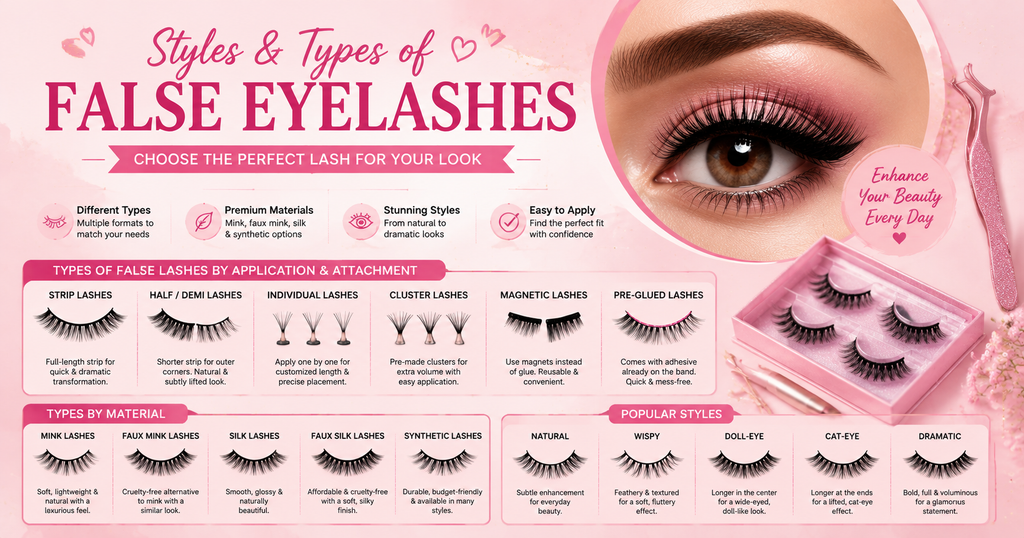
Types of False Lashes by Application & Attachment Format
1. Strip Lashes
Strip lashes are full-length false eyelashes made with multiple lash fibers attached to a single band that sits across the upper lash line.
They are available in many lengths, densities, shapes, and finishes, so you can choose anything from a soft, wispy effect to a fuller, more dramatic look.
Because the entire lash design is applied as one piece, strip lashes can be a practical option if you want a complete lash look without placing individual fibers or clusters one at a time.
Before applying a strip lash, hold the band against your lash line to check the fit and trim excess from the outer end if needed; an oversized band can feel uncomfortable, poke at the corners, or lift more easily.
Apply a thin layer of lash adhesive, allow it to become tacky according to the product directions, and position the band as close to your natural lash line as you comfortably can.
Placing the strip too high can leave a visible gap between your natural and false lashes, while skipping the sizing step can make an otherwise suitable style fit poorly.
2. Half / Demi Lashes
Half or demi lashes are partial strip lashes designed to cover mainly the outer portion of your upper lash line rather than extending from the inner to the outer corner like a full strip.
Demi lashes are half lashes that add length and volume toward the outer corners, while other major lash retailers also classify half lashes as a distinct false-lash format.
Because the shorter band concentrates the lash fibers toward the outside of the eye, demi lashes can create a softer, more elongated or subtly lifted effect without the density of a full-length strip.
Their reduced band length can also make placement easier to control, especially if a full strip feels too long for your lash line.
However, do not assume every half lash is automatically the correct size: align the band with your lash line first and trim it only if the particular design extends beyond the area where you want it to sit. Ardell gives this fit-check even for its half-lash products.
3. Individual Lashes
Individual lashes are small lash units applied one at a time, giving you much more control over where you add length, density, or definition than a full strip can provide.
Instead of covering the entire lash line with one fixed design, you can place a few individual lashes only where your natural lashes look sparse or build them gradually across selected areas to create anything from subtle definition to a fuller effect.
For a balanced result, start with fewer lashes and assess the shape before adding more; different lengths can be positioned strategically so the enhancement follows the look you want rather than creating the same density everywhere.
Adding too many units at once or concentrating them heavily in one spot can make the result look uneven, so building the design gradually gives you better control over the final shape.
One terminology detail is worth checking when you shop: some brands use “individual lashes” for true single strands, while others also include tiny flares or small multi-fiber units under the same label, so check the product construction rather than relying on the category name alone.
4. Cluster Lashes
Cluster lashes are small, pre-formed groups of multiple lash fibers joined at one base and applied in separate sections along the lash line.
Compared with true individual lashes, each cluster covers more area at once, so you can build noticeable fullness with fewer pieces while still controlling where extra length or density is placed.
In practice, this makes clusters a useful middle ground between individual lashes and a full strip: they provide more placement control than a fixed strip design but require less piece-by-piece work than single lashes.
You can combine different cluster lengths to shape the overall effect, but build gradually rather than placing several dense clusters in one area immediately; checking the balance as you go gives you better control over symmetry and prevents unnecessary bulk.
Some products marketed as individual flares or “individual lashes” are also constructed from several fibers on a small base, so check the actual construction rather than relying only on the product name.
Modern DIY cluster systems may also be designed for under-lash placement with their own bonding method, so follow the specific system’s directions instead of assuming every cluster is applied like a traditional top-applied false lash.
5. Magnetic Lashes
Magnetic lashes are false eyelashes that use magnetic attraction as their attachment mechanism instead of the conventional adhesive bond used by standard glue-on strip lashes. Two main systems are commonly available.
In a sandwich-style system, your natural lashes sit between an upper and lower magnetic lash strip, and the magnets on the two strips attract each other to hold the lashes in position.
Newer magnetic-liner systems use small magnets along the false-lash band that attach to a compatible magnetic eyeliner applied along your upper lash line. This difference matters when you apply them: do not assume every magnetic lash follows the same method.
With magnetic liner, apply the liner according to its specific directions and make sure the magnets contact the prepared liner along the band; with sandwich lashes, carefully align the paired strips rather than repeatedly pulling them apart against your natural lashes.
Magnetic lashes are available in different lengths, densities, and designs, so the magnetic attachment method does not determine whether the finished look will be natural or dramatic.
One unusual but important exception applies around medical imaging: magnetic eyelashes can create substantial MRI artifacts, so remove them and inform imaging staff before an MRI examination.
6. Pre-Glued Lashes
Pre-glued strip lashes are a subtype of strip lashes with self-stick adhesive already built into the lash band, so you can apply them without adding a separate layer of lash glue.
Current pre-glued strip systems are designed for over-lash placement: position the strip above your natural lashes, bring the band close to the lash line, and press it firmly into place to activate secure contact along the band.
This ready-adhesive design removes the separate glue-and-wait step, which can make application more convenient when you want a quicker or less messy alternative to traditional glue-on strips.
However, the built-in adhesive does not remove the need for careful positioning; if a corner is not sitting securely, press the band closer to the lash line rather than repeatedly shifting the entire strip after placement.
Pre-glued technology is also used on some lash clusters, so check the product format instead of assuming every product labeled “pre-glued” is a full strip.
Types of False Lashes by Material or Fiber
1. Mink Lashes
Mink lashes are false eyelashes made with real mink fur, so “mink” describes the lash fiber material rather than the application format; a mink lash can still be constructed as a strip or another false-lash format.
Real mink fibers are commonly chosen for their soft, lightweight appearance, but the material should not be confused with faux mink, which uses synthetic fibers engineered to imitate the look of mink.
This distinction is worth checking when you shop because terms such as “mink,” “mink-style,” and “faux mink” do not necessarily describe the same fiber composition; review the product’s material information instead of judging it by appearance or the word mink alone.
Cosmetic chemist guidance similarly recommends checking the product label or confirming the composition with the brand when the lash material matters to you.
If you specifically want an animal-free or vegan option, choose a product that clearly identifies its fibers as faux mink or synthetic rather than real mink.
2. Faux Mink Lashes
Faux mink lashes use synthetic fibers designed to imitate the soft, tapered appearance associated with real mink lashes, without using real mink fur.
Faux mink range is synthetic, while KISS similarly uses synthetic fibers engineered to reproduce a mink-like softness and taper. This makes faux mink a material or fiber category rather than a specific lash shape or application method: faux mink fibers can be used in strip lashes, clusters, and designs ranging from subtle and wispy to dense and dramatic.
When choosing them, look beyond the words faux mink and compare the fiber density, taper, length, layering, and band construction, because those design features determine much of how the lashes will actually look and feel on your eyes.
Also, do not automatically treat every “mink-like” product as vegan solely because of its appearance; if avoiding animal-derived materials matters to you, check the manufacturer’s material and vegan labeling.
3. Silk and Faux Silk Lashes
Silk and faux silk lashes are commonly associated with a smooth, polished finish and more defined sheen, but the word silk on lash packaging does not always tell you exactly what the fibers are made from.
Faux silk lashes are like synthetic fibers engineered to imitate the smooth, glossy appearance associated with silk, and they tend to look slightly shinier than its faux mink styles.
This makes the distinction important when you are choosing lashes by material: faux silk clearly refers to a silk-inspired synthetic fiber, while products simply marketed as silk lashes may use the term to describe their finish, construction, or product range rather than guaranteeing literal silk fiber—ModelRock, for instance, markets several “Silk” lash styles without defining their fiber composition on the supplied guide page.
Forabeli likewise treats silk as a lash-material category but does not establish that every product carrying the label uses natural silk. If the exact material matters to you for ethical, allergy, or purchasing reasons, check the manufacturer’s fiber specification instead of relying on the word silk alone.
4. Synthetic Lashes
Synthetic lashes are false eyelashes made from man-made fibers rather than animal hair or other natural lash fibers.
They form a broad material family rather than one specific look: faux mink and faux silk lashes, for example, can both use synthetic fibers while being engineered for different textures and finishes.
Faux mink fibers are lightweight and wispy and its synthetic faux silk fibers are smoother and slightly glossier, showing why synthetic does not automatically mean stiff, shiny, or unnatural-looking.
Modern synthetic fibers can also be finely tapered, layered, curled, or given matte finishes to create everything from subtle everyday lashes to dense, dimensional styles.
When choosing synthetic lashes, look beyond the material name and compare the fiber taper, thickness, density, length pattern, layering, and band construction, because these design details have a major influence on how the finished lash looks and sits on your eye.
Forabeli likewise identifies synthetic as one of the main material options used in false eyelashes. If avoiding animal-derived materials is important to you, still check the complete product’s vegan labeling rather than assuming the word synthetic alone confirms every component is animal-free.
Styles of False Eyelashes
1. Wispy Lashes
Wispy lashes are defined by an airy, feathered pattern of alternating or staggered lash lengths rather than a uniformly dense lash edge.
Shorter and longer fibers, soft spikes, light layering, or subtle crisscrossing create separated peaks that add texture and dimension while leaving visible space between some fibers.
Wispy is therefore a style pattern, not a fixed level of volume: a lightly spaced wispy design can look soft and understated, while longer, denser or multilayered wispy lashes can create a much more dramatic finish.
Wispy lashes are an option for softer looks, while ModelRock also sells high-volume “Mega Wispies,” illustrating that distinction.
When choosing a wispy style, compare the spacing between spikes, variation in fiber length, overall density, and lash shape instead of assuming every pair labeled wispy will produce the same effect.
2. Natural / Classic Lashes
Natural or classic false lashes are designed to enhance your existing lash line without making the added volume or length look overly obvious. They typically use lighter density, restrained length, and a softer distribution of fibers.
A convincing natural effect depends on more than simply using fewer fibers: fine or tapered tips, slight variation in lash length, soft curl, a less glossy finish, and a thin or discreet band can help the false fibers blend more smoothly with your own lashes.
When choosing this style, compare the lash density and length with your natural lashes rather than relying only on a product labeled natural; a design that closely complements what you already have will usually create the most understated enhancement.
Here, classic describes the visual style and should not be confused with the one-extension-to-one-natural-lash technique known as classic eyelash extensions.
3. Dramatic / Volume Lashes
Dramatic or volume false lashes are designed to create a noticeably fuller, bolder lash line through greater fiber density, added length, layering, or a combination of these features.
The important distinction is that dramatic does not describe one fixed construction: a full strip, flare, cluster, or layered “3D” design can all produce a high-volume look when enough fibers and dimensional layering are used.
When choosing volume lashes, compare the overall density, fiber length, spacing, and number of visible layers rather than relying only on words such as dramatic, full, or volume on the packaging, because two products carrying the same style label can differ considerably in visual intensity.
Here, volume refers to the appearance of fullness in a false-lash style; it should not be confused with professional volume eyelash extensions, which use a different application technique.
4. Cat-Eye / Fox-Eye Lashes
Cat-eye and fox-eye lashes create an elongated, outward-sweeping effect by keeping the inner fibers shorter and increasing emphasis toward the outer part of the lash line.
In a typical cat-eye design, the lengths graduate progressively toward the outer third, creating a soft winged or feline shape.
Fox-eye styles use a similar outer-focused pattern but often create a sharper, more directional lift, giving the outer edge a sleeker and more extended appearance. The amount of elongation depends on the actual length map, curl, density, and angle of the fibers, so two lashes marketed under the same style name can produce noticeably different results.
If your goal is stronger horizontal elongation, look for a clear short-to-long progression with controlled outer-corner emphasis rather than choosing by the cat-eye or fox-eye label alone.
Avoid excessively long or heavy outer fibers if they visually pull the outer edge downward instead of creating the lifted effect you want.
5. Doll-Eye / Open-Eye Lashes
Doll-eye or open-eye lashes use a rounded length pattern that places the longest fibers near the center of the lash line, with shorter lengths toward the inner and outer corners.
This center-focused height draws visual attention upward rather than outward, helping the eyes appear more open, rounded, and prominent.
The effect can range from soft and natural to highly dramatic because doll-eye describes the distribution of lash length, not a fixed amount of volume; density, curl, layering, and fiber length still determine the overall intensity.
When choosing this style, look for a noticeable central peak with a gradual taper on both sides. If the outer fibers remain as long as—or become longer than—the center, the design begins to create a more elongated or flared effect instead of the characteristic open-eye shape.
6. Accent / Outer-Corner Lashes
Accent or outer-corner lashes concentrate added length, density, or both toward the outer portion of your lash line instead of distributing the same emphasis across the entire eye.
This targeted placement can add subtle definition and create a softly lifted or elongated effect without the visual weight of a full, evenly dense lash.
Accent styling can be created with a shorter half-lash design or with smaller lash sections positioned specifically where you want additional emphasis; what defines the style is the outer-focused effect rather than one fixed lash construction.
When choosing an accent look, pay attention to how gradually the fibers become longer or fuller toward the outer third—a gentle progression gives softer enhancement, while a stronger increase creates a more noticeable winged finish.
Keep the outermost fibers properly supported along your natural lash line rather than extending an oversized section beyond the eye, as poor fit can make the outer edge feel uncomfortable or lift away from the lash line.
7. Russian-Style Volume Lashes
Russian-style volume false lashes are designed to recreate the dense, fluffy, multidimensional appearance associated with salon Russian volume extensions in a removable false-lash format.
These styles typically combine high fiber density with pronounced curl, layered lengths, and fine tapered fibers, creating a darker and fuller lash line while retaining visible texture rather than forming one flat block of volume.
Some extension-inspired strip lashes also mix different curl patterns and fiber angles to create more dimension across the lash line.
When choosing this style, compare the actual density, curl, layering, and length pattern rather than relying on the word Russian alone, because the label does not describe one standardized false-lash construction or intensity.
Traditional Russian volume, however, is a professional eyelash-extension technique in which multiple fine extensions are formed into volume fans and applied to individual natural lashes, so it is technically different from temporary false lashes marketed with a Russian-volume-inspired look.
How to Choose the Right False Lash Type and Style for Your Eye Shape
Your eye shape is a useful starting point for choosing false lashes, but it should not be treated as a strict rule.
The better approach is to first decide what you want the lashes to do—elongate the eyes, create more vertical openness, emphasize a natural lift, add balanced fullness, or keep the result subtle—and then choose a lash length pattern that creates that effect.
Professional beauty guidance similarly matches flared styles with visual elongation and rounder, center-focused styles with a more open appearance.
Band fit matters as well: even a flattering style can feel uncomfortable if the strip is wider than your natural lash line, so check the fit and trim excess from the outer end when necessary.
| Eye Shape | Lash Type & Style to Consider | Why It Can Work |
| Almond Eyes | Natural, wispy, balanced-volume, half/demi, cat-eye | Almond eyes are versatile. A balanced lash preserves their natural proportions, while outer-corner emphasis can make the existing almond shape more pronounced. |
| Round Eyes | Cat-eye, fox-eye, wispy flared, half lashes | If you want a more elongated appearance, shorter inner fibers with progressively longer outer fibers direct attention outward rather than adding more central roundness. Flared styles are commonly recommended for this effect. |
| Hooded Eyes | Lightweight natural lashes, wispy styles, moderate open-eye patterns | Short-to-moderate fibers and controlled density can add definition without placing unnecessary visual weight over limited visible lid space. A little extra central length can emphasize vertical openness. |
| Monolid Eyes | Curled wispy lashes, natural-to-medium volume, open-eye or softly graduated styles | Curl and visible separation can add definition above the lash line, while moderate length keeps the style from visually overwhelming the lid. Rounder lash patterns are also commonly recommended when greater openness is the goal. |
| Close-Set Eyes | Cat-eye, fox-eye, half/demi, outer-corner accent lashes | Concentrating length toward the outer third can visually draw attention outward and create more horizontal extension. |
| Wide-Set Eyes | Balanced full strips, natural/classic styles, doll-eye or softly center-focused lashes | If you want the eyes to appear more visually balanced, an even or center-focused distribution can add definition without pushing the emphasis farther toward the outer corners. |
| Upturned Eyes | Cat-eye, fox-eye, wispy flared lashes | Outer-focused lashes can reinforce the eye’s existing upward direction and make the natural lift more noticeable. Choose a balanced style instead if you do not want to exaggerate that angle. |
| Downturned Eyes | Lightweight half lashes, softly lifted outer-corner styles, restrained fox-eye patterns | Carefully controlled outer emphasis can create a lifted visual direction, but excessively long or dense fibers at the extreme outer edge may emphasize downward weight instead. |
| Deep-Set Eyes | Longer curled lashes, wispy volume, dramatic styles | Deep-set eyes can often accommodate more visible length and curl because the eye sits farther beneath the brow area. Longer styles can bring the lash line forward visually, but the fibers should still clear the brow bone comfortably. |
The most flattering option is ultimately the one that combines your eye shape with your desired effect, natural lash direction, available lid space, and comfortable band fit.
Two people with the same general eye shape may prefer completely different false lashes because one wants subtle definition while the other wants strong elongation or dramatic volume.
False-lash styles are therefore best treated as tools for shaping a look rather than fixed rules for particular eye shapes.
Conclusion
Choosing the right false eyelashes becomes easier when you understand the difference between lash types, materials, and visual styles.
Strip, individual, cluster, magnetic, and pre-glued lashes differ mainly in how they are applied or constructed, while mink, faux mink, silk, faux silk, and synthetic options describe the fibers used. Styles such as wispy, natural, dramatic, cat-eye, doll-eye, accent, and Russian-inspired volume change the overall effect.
Your best choice depends on your desired look, eye shape, comfort, and preferred application method. By comparing these features instead of relying only on product labels, you can choose false lashes more confidently and find a style that best suits your eyes and makeup goals.