

Published On: 06 Jan 2026
Leg waxing sounds simple, but once you start looking into it, questions pop up from everywhere. What exactly is leg waxing? Is full leg waxing better than half leg waxing? How long do the results actually last, and what affects that timing?
This leg waxing answers all of those common questions related to leg waxing clearly and honestly. You’ll learn about leg waxing types, longevity, costs, pain level, and whether leg waxing is safe during periods or pregnancy.
We’ll also break down the key factors that influence waxing results and share practical tips to help your legs stay smooth for longer. By the end, you’ll have a clear understanding of leg waxing—without confusion, myths, or guesswork.
What is Leg Waxing
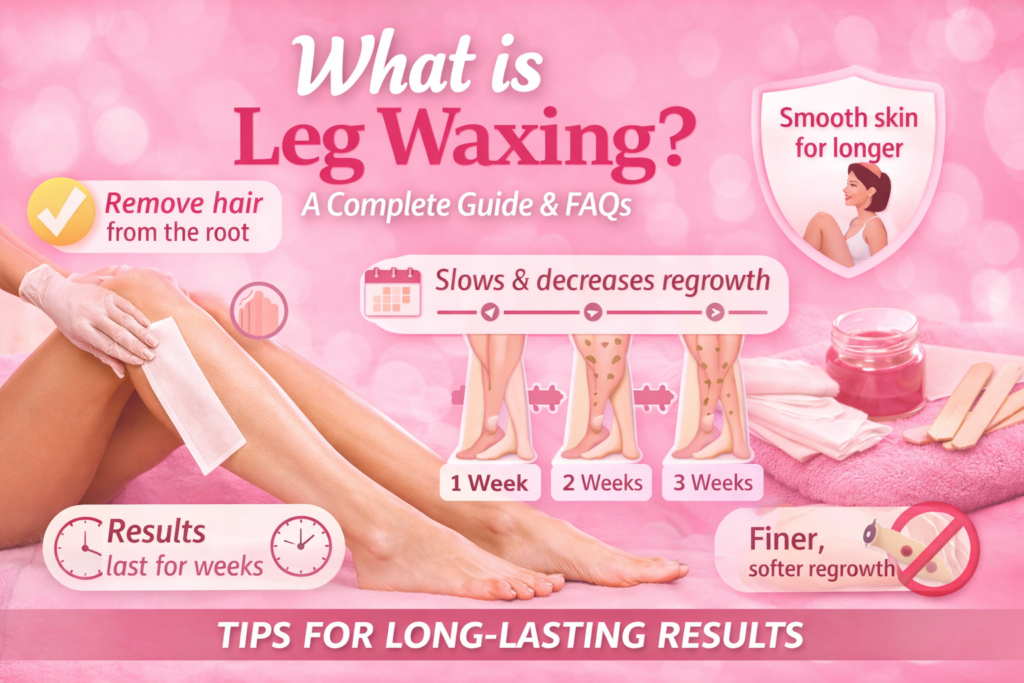
So, what exactly is leg waxing? Simply put, it’s a hair-removal technique used to get rid of unwanted hair from the legs using different types of wax. Unlike shaving—which only cuts the hair at the surface—waxing removes hair directly from the root. That one difference makes a big impact, and honestly, it’s why many people prefer it.
At first, you might wonder, does removing hair from the root really matter? Yes, it does. Over time, waxing helps slow down hair growth, and the hair that grows back often feels softer and finer. That’s a pretty satisfying result, especially if smooth skin is your goal.
Because of these benefits, leg waxing has become increasingly popular for grooming unwanted hair—not just on legs, but on different body areas as well. People are clearly excited about its long-lasting results, and the numbers back this up. In fact, research shows that the global wax market was valued at $10,456.0 million in 2023 and is expected to reach $14,165.8 million by 2030, growing at a CAGR of 4.6% from 2024 to 2030.
With results like that, it’s not surprising that waxing continues to be a go-to choice for effective and reliable hair removal for legs too.
What is Full Leg Waxing
So, what does full leg waxing actually mean? It’s a type of leg waxing categorized by the areas of the legs where hair is removed. In full leg waxing, hair is completely removed from the upper thighs all the way down to the ankles—covering both the front and back of the legs.
To break it down simply, a full leg waxing includes the upper thigh area (front and back) and continues from the knees down to the ankles on both sides. Nothing is skipped. No patches are left behind. And yes, that “fully smooth” result is exactly what makes this option so popular.
You might ask yourself, is full leg waxing really worth it? For many people, the answer is a happy yes. It’s especially preferred by those who love complete hair removal or enjoy wearing short skirts, dresses, or outfits that show off smooth legs with confidence.
In short, full leg waxing offers a thorough and long-lasting solution for anyone who wants clean, evenly smooth legs from top to bottom—simple, effective, and satisfying.
What is Half Leg Waxing
Like full leg waxing, half leg waxing is also categorized based on the specific areas of the legs where hair is removed. The difference is simple but important. In half leg waxing, only half of the leg area is waxed instead of the entire leg.
Now, you might wonder, which half exactly? It can be either the upper portion—from the thighs down to just above the knees—or the lower portion, from the knees to the ankles. The choice depends entirely on personal preference and lifestyle.
This type of waxing is especially popular among people who enjoy wearing long socks from ankle to knee or outfits that fully cover the thighs up to the knees. In those cases, waxing the entire leg may feel unnecessary, and half leg waxing becomes a practical and satisfying option.
Another advantage—one that often brings a small sense of relief—is cost. Compared to full leg waxing, half leg waxing is more affordable because a smaller area is treated, less product is used, and the service takes less time. As a result, the overall bill is lower.
In short, half leg waxing offers flexibility, comfort, and affordability, making it an ideal choice for anyone who wants effective hair removal without committing to a full leg wax.
Is It Good to Wax Your Legs
Haha, yes—obviously, this is probably the main reason the waxing market keeps growing year by year. People genuinely like leg waxing. And honestly, why wouldn’t they? There are so many benefits.
Let’s talk about just one of them. With consistent leg waxing, hair growth becomes slower and finer over time. Now you might be thinking, wait… am I joking here? Nope, not at all.
There was a previous research study that showed something interesting: when waxing is done using sugar wax, hair regrowth after sugaring was slower, thinner, and less dense over a four-week period. That’s a pretty solid reason to take leg waxing seriously, right?
And that’s not even all. There are many more benefits that make leg waxing a good option for hair removal. Want to know all of them? Fair enough—we’ve written a detailed article on the benefits of waxing leg, where you can explore the pros and cons properly and in detail.
How Long Will a Leg Wax Last
A leg wax usually lasts for about 2 to 3 weeks. During this time, hair doesn’t really show up, and your legs stay nicely smooth—which honestly feels great. The hair is growing underneath, of course, but it’s so fine and light that it’s barely noticeable.
After that, things slowly start to change. Over the next week, the hair begins to appear more clearly, and by the fourth week, it has usually grown long enough to be waxed again. That’s why many people end up waxing their legs once every four weeks.
But—and this is important—this rule doesn’t apply to everyone.
There are several factors that affect how long leg waxing lasts. Curious to know what those factors are? Alright then, let’s take a closer look at them.
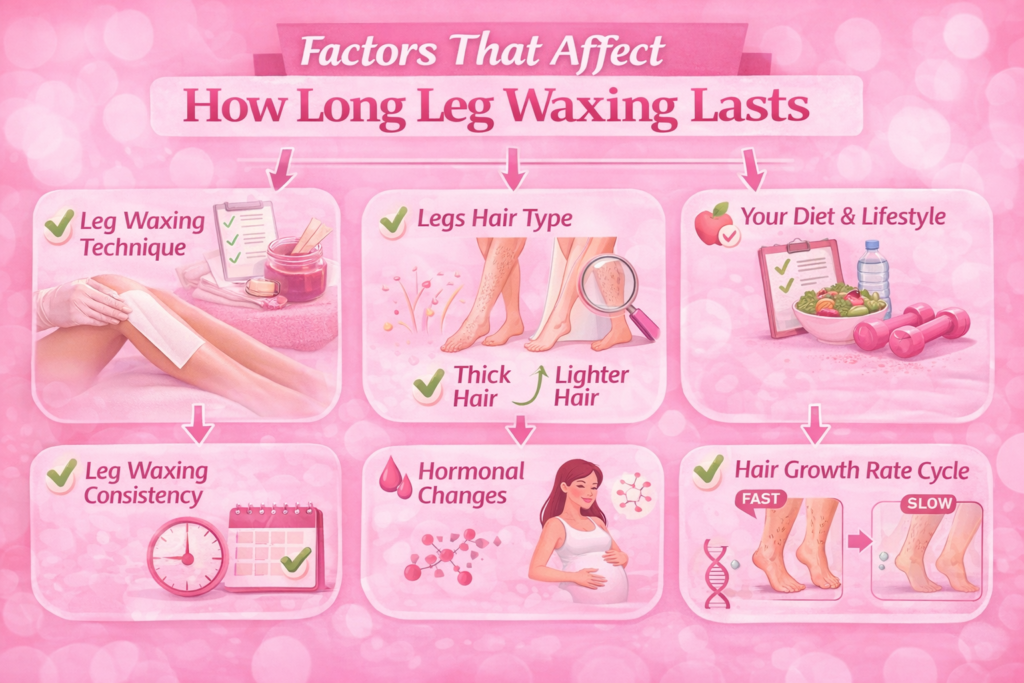
Factors That Affect How Long Leg Waxing Lasts
1. Leg Waxing Technique
The very first thing that affects how long your leg waxing lasts is the waxing technique and service you used to remove the leg hair. Think about it—if the right technique isn’t used, will the hair really be removed from the root? Of course not.
And let’s be honest, if the waxing service is poor, can you expect clean, smooth skin without patches? Nope. That’s exactly why the waxing technique plays such a big role in deciding how long your leg waxing results will last and how soon you’ll need your next reappointment.
In simple words, the better the technique, the longer your legs stay smooth—and the more time you get before waxing again.
Now listen, if you’re living in Dubai and looking for a high-quality leg waxing service that follows proper techniques, then choosing a professional service really matters. We offer home leg waxing services in Dubai with affordable pricing and quality results—so you get smooth skin without the stress.
2. Legs Hair Type
The second factor that affects how long your leg waxing lasts is your leg hair type. If the hair on your legs is thick, it usually grows back faster, and as a result, leg waxing tends to last for a shorter time.
But if your leg hair is thinner, hair regrowth takes a little longer. In that case, your leg waxing will last longer, which honestly feels like a win.
And before you ask—any proof? Yes, there is. I don’t say things without evidence. Research has shown that thinner hairs grow more slowly than thicker hairs. So yes… that explains everything. Now you can relax.
3. Your Diet & Lifestyle
Haha, yes—you heard that right 😄 diet and lifestyle matter too. We’re talking about leg waxing longevity here, but let’s be real for a second—your diet and lifestyle affect your entire body, so why wouldn’t they affect hair growth as well?
If your diet is healthy and your lifestyle is balanced, your body works differently. In fact, studies show that nutrients can induce active hair growth by supporting a high metabolic rate and rapid cell division. So yeah, what you eat and how you live can quietly decide how fast your leg hair grows—and how long your leg waxing lasts.
4. Leg Waxing Consistency
Leg waxing consistency also decides how long legs waxing last. It means leg waxing longevity also depends on whether you get your legs waxed regularly and how often you do it. It doesn’t work like this that one time you wax your legs and the next time you switch to shaving—this kind of inconsistency directly affects how long your leg waxing results will last.
Generally, it is believed that when leg waxing is done consistently, hair regrowth becomes slower over time. The hair grows back finer, and waxing starts to last longer with each session. So, sticking to a regular waxing routine—without switching methods in between—plays an important role in achieving better, longer-lasting results.
5. Hormonal Changes
Hormonal changes are another factor that decides how long leg waxing will last. If your hormones are balanced, hair growth and regrowth usually stay normal, and waxing results last as expected. But when there is hormonal imbalance—which commonly happens during periods or pregnancy—hair can grow back faster and sometimes thicker than usual.
In such situations, leg waxing doesn’t last as long as it normally would. So yes, hormonal changes can directly affect the longevity of leg waxing, even if your routine and technique are perfect.
6. Hair Growth Rate Cycle
How long leg waxing lasts also depends on each individual’s hair growth rate cycle. Everyone’s body works differently. Some people have a faster hair growth cycle, which means their leg hair grows back quickly, and in that case, leg waxing doesn’t last as long. On the other hand, people with a slower hair growth cycle enjoy longer-lasting leg waxing results.
This isn’t an assumption—it’s a fact. Medical News Today has clearly stated that everyone’s hair grows at different rates, and several factors influence this speed. These include genetics, sex, and age.
Because of these differences, two people can get leg waxing done on the same day but experience very different regrowth timelines. That’s why leg waxing results are never exactly the same for everyone.
Tips to Make Leg Waxing Results Last Long
Alright, now we understand that leg waxing longevity depends on several factors—and yes, some of them are completely out of our control, like hair type or hair growth cycle. But does that mean we just sit back and do nothing? Of course not.
You still have plenty of control. The key is proper aftercare. The better you take care of your skin after leg waxing, the longer your leg waxing results will last. Simple steps, done consistently, can make a real difference.
Now you might be thinking, okay… but how exactly? Hold on—I won’t explain it all here. We’ve written a complete and detailed guide on leg waxing aftercare. Give it a read, and you’ll learn everything you need to achieve longer-lasting waxing results.
How Often to Wax Legs
Normally, you should wax your legs every fourth week, but remember—that’s just a general rule. Your personal schedule can change depending on the factors that affect how long your leg waxing lasts. So now you’re probably thinking, okay… then what should I actually follow?
Here’s a simple rule—lock it in your mind:
Grain-size hair length = waxing appointment time.
Didn’t get it? No worries. What I mean is, when your leg hair grows to about the size of a grain, that’s your cue to book a waxing appointment. Why? Because that’s the ideal length for waxing.
Still need proof? According to the American Academy of Dermatology, hair should be about one-fourth to three-fourths of an inch long before waxing—and yes, that’s almost equal to grain-size length. Simple, right?
How Much Does Leg Waxing Cost
Well… it depends. The first thing it depends on is this: are you asking about full leg waxing or half leg waxing? Because yes, that alone changes the price. Then comes the next question—which type of wax do you want to use? Soft wax, hard wax, sugar wax, or something else? Each option comes with its own cost.
And honestly, one of the biggest factors is location. Waxing prices won’t be the same everywhere. What you pay in Washington can be very different from what you pay in Dubai.
So, Dubai? Alright, here’s something simple and clear. At Pink Beauty Salon Dubai, home leg waxing service costs just 60 AED for full leg waxing. No confusion, no hidden charges—just smooth legs and good vibes. Enjoy.
Does Leg Waxing Hurt
Yes, leg waxing does hurt—of course it does. But the real question is, how much? And honestly, that depends on several factors. First of all, it depends on you. Is this your first time, or do you wax regularly? If it’s your first time, you’ll probably feel more pain compared to someone who gets leg waxing done often.
After that, the pain level also depends on the type of wax being used—soft wax, hard wax, or sugar wax. Among these, sugar wax is generally considered less painful because it’s gentler and safer for sensitive skin.
Then comes skin type. Sensitive skin usually feels more pain. The area of the legs also matters—bony areas like shins and ankles tend to be more uncomfortable.
Still, overall, there’s nothing to panic about. I’m pretty sure you can handle it, because leg waxing pain is much less compared to more sensitive areas like bikini or Brazilian waxing.
How Long Do Legs Hurt After Waxing?
During the session, while your legs are being waxed, it’s normal to feel a sharp sting or a quick pinch. After all, the hair is being pulled out from the root with a sudden tug. Once the waxing is done, some sensitivity or irritation can continue—but usually only for 12 to 24 hours.
That said, proper pre-wax preparation and good aftercare can significantly reduce the discomfort you feel during and after leg waxing. The better you prepare your skin, the smoother the experience tends to be.
Now you might ask, what exactly is proper leg preparation before waxing? I won’t go into all the details here. For that, check out our detailed article on how to prepare legs for waxing—it covers everything you need to know.
Can Pregnant Women Wax Their Legs
Yes, pregnant women can wax their legs.
However, pregnancy brings hormonal changes, and those hormones can make the skin more sensitive than usual. Because of this, leg waxing may feel more painful, and you might notice more redness or irritation during and after the session.
That’s why it’s always a good idea to inform your waxing professional that you’re pregnant. A patch test before full leg waxing, along with a gentle technique and proper aftercare, can help reduce discomfort and keep your skin calm and safe.
Can You Get Leg Waxing During Periods?
Yes, you can get leg waxing during your periods, but it may feel more uncomfortable than usual. During menstruation, according to research, hormonal changes increase skin sensitivity, which means leg waxing can feel more painful and may cause extra redness or irritation.
Because of this increased sensitivity, many experts recommend avoiding leg waxing during periods if you can wait. However, if you choose to go ahead, it’s important to inform your waxing professional so they can use a gentle technique and proper care.
With the right approach and good aftercare, leg waxing during periods is still manageable—just be prepared for slightly more discomfort than normal.
How to Wax Legs at Home
Thinking about waxing your legs at home? Fair enough—it’s a common thought. But instead of cramming everything here, let me be honest with you: we’ve already written a complete, detailed, and easy-to-follow guide on this topic.
If you really want to know how to wax legs at home properly, without mistakes, unnecessary pain, or patchy results, then that article is worth your time. It covers everything step by step, in simple language, so you don’t feel confused halfway through.
So yeah—before trying it on your own, go read that guide. You’ll learn a lot, and your legs will thank you later.
What Are the Products People Often Use While Doing Leg Waxing
One thing to be very clear about—there is no single guide that covers everything in one place. Instead, we’ve created detailed listings and separate sections for the best leg waxing products, so you can choose what actually suits you.
We’ve carefully listed and explained options like the best wax for legs, best wax strips for legs, and the best at-home waxing kits for legs—each in its own section, with proper details and comparisons.
So if you’re feeling confused about which product to pick, don’t worry. Just go through those listings. They’ll help you understand the differences, make better choices, and avoid common mistakes while doing leg waxing at home.
Conclusion
Leg waxing is a reliable and effective way to achieve smooth, clean legs, but its results depend on more than just the waxing session itself. Factors like waxing technique, hair type, growth cycle, consistency, and even hormonal changes all play an important role in how long the results last.
While some things are out of your control, proper aftercare, regular waxing, and informed choices can make a noticeable difference. Understanding what to expect—from cost and pain to timing and maintenance—helps you avoid surprises and get better results.
With the right knowledge and approach, leg waxing can be a simple, confidence-boosting part of your grooming routine.