
Published On: 22 August 2026
Traditional false eyelashes usually work best when you apply them after most of your makeup, but the correct order can change with the lash system you use.
This article explains why glue-on strip lashes are generally placed near the end of your routine, how applying them later can keep the fibers cleaner, and when lashes may need to go on earlier.
You will also learn how self-adhesive, magnetic, adhesive-liner, and underlash cluster systems follow different preparation and timing rules.
We also cover common makeup-order mistakes, what to do if cosmetics get on the lash fibers, how to correct a shifted band, and when irritation means you should stop. Keep reading to match your lash type with the right makeup order.
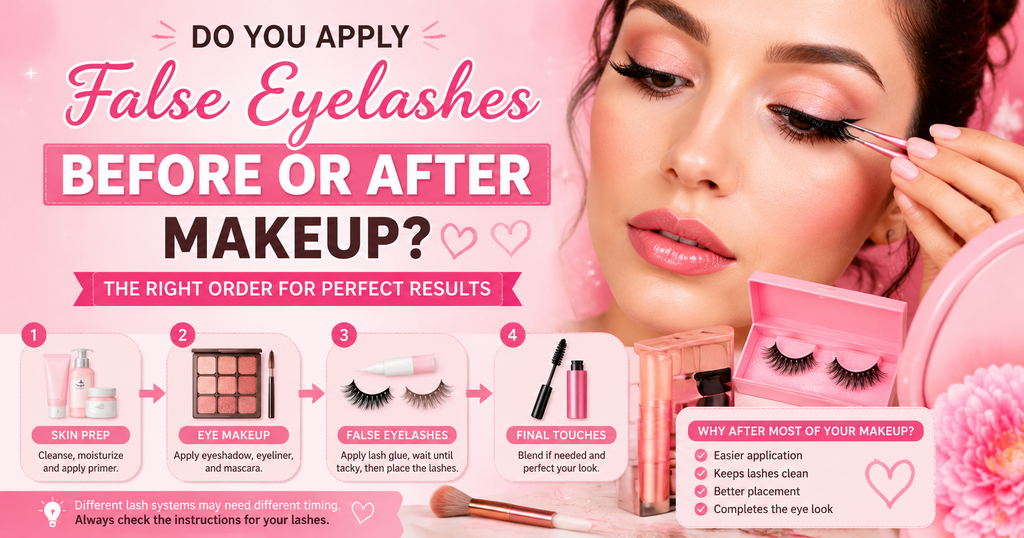
Apply Traditional False Eyelashes After Most of Your Makeup
Apply traditional glue-on false eyelashes after completing most of your makeup. Finish the main face and eye makeup first so you can blend, define, and refine the look without working around an attached lash band.
Standard strip-lash application guidance also places lash-line makeup and natural-lash preparation before the adhesive and false lash are applied.
Once your makeup is largely complete, apply a thin layer of lash adhesive to the strip band and let it reach the tacky stage specified by the product before positioning the lash close to your natural lash line.
Small finishing corrections can still be made after the strip is secure, so false lashes are best treated as one of the final major steps rather than the absolute last touch of your makeup routine.
Read Here: what are false eyelashes
Why False Eyelashes Usually Go On After Most of Your Makeup
You Can Complete Your Makeup Without Working Around a Lash Band
Finish your main eye makeup before attaching traditional strip lashes so you have unobstructed access to the eyelid.
An attached lash band sits along the upper lash line, where it can make precise blending and other eye-makeup adjustments more awkward.
Completing the eye look first also reduces the need to move brushes or applicators around a freshly secured strip. Standard strip-lash instructions follow this general sequence by placing lash-line makeup and natural-lash preparation before adhesive and false-lash application.
Once the main makeup is complete, you can position the false lashes without needing to work extensively around them afterward. Small finishing corrections can still be made once the lash band is secure.
Applying Lashes Later Keeps the Lash Fibers Cleaner
Apply reusable false lashes near the end of your makeup routine to reduce unnecessary cosmetic buildup on the lash fibers.
Products such as loose powder, foundation, concealer, and eyeshadow can settle onto false lashes when they are already attached during the rest of your makeup application.
Product buildup can make reusable lashes harder to keep clean and may affect their appearance over repeated wears.
False-lash care guidance similarly recommends limiting cosmetic buildup on reusable fibers to help preserve their condition. Finishing most of your makeup first therefore keeps brushes and complexion products away from the false lashes until the main application work is complete.
Final Lash Placement Completes the Eye Look
Applying traditional strip lashes after most of your makeup lets you see the finished shape and intensity of the eye look before securing the lash band.
You can then position the strip close to your natural lash line and assess how the lash style works with the completed makeup rather than designing the rest of the look around an already attached band.
Traditional false-lash guidance also treats strip-lash placement as one of the final stages of makeup application. Once the strip is positioned and secure, only small finishing adjustments should normally be needed around the eye.
Can You Apply False Eyelashes Before Makeup
Yes, you can apply false eyelashes before makeup in some cases, but this is not usually the preferred order for traditional glue-on strip lashes.
Standard strip-lash instructions commonly place eye makeup and natural-lash preparation before the false lash is attached, and some professional lash guidance treats strip lashes as the final major step of the makeup routine.
The order can change when the attachment system works differently. Some self-adhesive lashes can be applied before or after eye makeup, and certain products perform best when their adhesive band contacts clean, dry skin.
Magnetic lashes also follow their own sequence because compatible magnetic eyeliner must be applied before the lash. Check the attachment method first rather than applying one makeup order to every type of false eyelash.
Some False Lash Systems May Need a Different Makeup Order
Self-Adhesive Lashes May Work Better on Clean, Dry Skin
Apply self-adhesive false lashes according to the preparation required by their pre-glued band rather than automatically following the traditional strip-lash sequence.
Some self-adhesive systems can be worn over completed eye makeup, but their manufacturers recommend clean skin when stronger or longer-lasting adhesion is the priority.
A clean, dry eyelid gives the adhesive band direct contact with the skin instead of placing it over layers of eyeliner, eyeshadow, oil, or other cosmetics. Heavy eyeliner and oily eyelids can also interfere with the performance of some self-adhesive bands.
For these systems, applying the false lashes before the rest of your eye makeup may therefore be the better order. However, this is product-specific, so follow the preparation instructions supplied with your particular self-adhesive lashes.
Magnetic Lash Systems Follow Their Own Application Sequence
Magnetic-liner false lashes follow a different sequence because the compatible magnetic eyeliner forms part of the attachment system.
Apply the required magnetic liner before positioning the lash strip so the magnets along the lash band have the intended surface to attach to.
Manufacturer instructions for magnetic-liner systems place the liner before the false lashes and require it to reach the specified drying stage before placement.
This means magnetic lashes should not simply be treated as traditional glue-on strips that are added after every other makeup step.
Follow the sequence provided with your magnetic lash system because liner preparation and drying requirements can vary between products.
Adhesive-Liner Systems Follow Product-Specific Timing
Follow the timing instructions for your adhesive-liner system because the liner itself creates the bonding surface for the false lash.
Some glue liners are designed to hold the lash only while the formula remains wet or semi-wet. DUO, for example, instructs users to place false lashes while its adhesive eyeliner is still semi-wet.
KISS similarly instructs users to attach the lash strip before its GLUEliner has a chance to dry. This means the normal makeup rule of allowing eyeliner to dry completely does not apply to every adhesive-liner system.
Apply the liner and attach the lash within the working stage specified for your exact product.
Underlash Cluster Systems May Start With Clean Natural Lashes
Some underlash cluster systems require clean, prepared natural lashes because the bond is applied directly to the natural lashes rather than to a strip band on the eyelid.
KISS Falscara specifically instructs users not to apply mascara before or after the system and instead starts the application with a light coat of bond on the natural lashes.
The same system also offers a pre-application cleanser designed to remove residue from natural lashes and improve adhesion and retention.
Ardell likewise advises that natural lashes should be clean and oil-free before applying its underlash Bond & Seal system. Underlash clusters therefore should not automatically follow the same makeup order as traditional glue-on strip lashes.
How Lash Type Changes When You Should Apply False Eyelashes
The best point in your makeup routine for applying false eyelashes depends on how the lashes attach.
Traditional glue-on strip lashes usually go on after most of your makeup is complete. Self-adhesive lashes may go on before or after makeup, depending on whether the pre-glued band performs best on clean skin.
Magnetic liner lashes must follow the application sequence required by their compatible magnetic eyeliner.
Adhesive-liner lashes need to be attached during the working stage specified for the glue liner.
Underlash clusters follow their own bond-and-seal process and may require clean, product-free natural lashes. Identify the attachment system first, then follow its specific application instructions.
Common Makeup-Order Mistakes With False Eyelashes
Applying Traditional Strip Lashes Too Early
Avoid attaching traditional strip lashes while you still have substantial eye makeup left to apply. An attached lash band occupies the upper lash line and can make later blending or precise brush work less convenient.
Completing most of the eye look first also reduces the amount of cosmetic product that can fall onto the false lashes during application. Standard false-lash guidance therefore commonly places traditional falsies near the end of the makeup routine.
Apply the strip once the main makeup work is complete, then reserve only small finishing corrections for afterward.
Getting Too Much Makeup on Reusable Lash Fibers
Keep unnecessary foundation, powder, eyeshadow, and other cosmetics off reusable false-lash fibers.
Product deposited onto the hairs becomes additional residue that must be removed during lash care, while reusable lashes depend on gentle cleaning and proper storage to remain suitable for repeated wear.
Applying reusable lashes near the end of your routine reduces their exposure to makeup brushes, loose powders, and complexion products.
If product does reach the lash fibers, follow the manufacturer’s cleaning instructions after removal instead of rubbing the lashes aggressively while they are attached.
Applying Heavy Makeup Where a Self-Adhesive Band Needs to Grip
Avoid creating a heavy cosmetic layer directly where a self-adhesive lash band needs to contact the eyelid when your lash system recommends clean-skin application.
Some self-adhesive lashes can be worn over completed eye makeup, but their manufacturer recommends clean skin for better performance and durability.
Applying the band directly to clean, dry skin removes a layer of makeup between the pre-applied adhesive and the eyelid.
If you prefer to wear these lashes over makeup, follow the instructions for your specific product rather than assuming every self-adhesive band performs identically.
Continuing Makeup Before the Lash Band Is Secure
Give a traditional strip lash time to secure before continuing makeup around the lash line. Strip-lash adhesive is normally allowed to become tacky before placement, and the band is then gently pressed into position so the adhesive can hold it against the eyelid.
Moving brushes or applicators against the band immediately after placement can disturb a strip that has not yet stabilized. Follow your adhesive’s setting instructions, then make only the finishing corrections that are actually necessary.
Using One Makeup Order for Every False Lash Type
Do not use one makeup sequence for every false-lash system because the attachment method determines when the lashes should be applied.
Traditional glue-on strips generally fit near the end of the makeup routine, while some self-adhesive bands perform best on clean skin.
Magnetic-liner lashes require their compatible liner before lash placement, whereas other systems can have different preparation and attachment requirements.
Identify whether you are using a glue-on, self-adhesive, magnetic, or another specialized lash system first, then follow the application order provided for that product.
What to Do if Makeup Gets on Your False Eyelashes
If makeup gets onto your false eyelashes while you are wearing them, avoid rubbing or scrubbing the lash fibers to remove it.
Friction can distort the shape of delicate reusable fibers and put unnecessary pressure on the attached band. If the residue does not need immediate removal, leave thorough cleaning until after you take the lashes off.
Reusable false lashes should be cleaned gently according to their manufacturer’s instructions.
Some lash-care instructions recommend using a makeup remover with a cotton tip to clean the fibers and band after removal rather than aggressively wiping the lashes while they are attached.
Handle the band rather than pulling on individual fibers during removal and cleaning to help preserve the lash shape.
What to Do if Makeup Disturbs Your False Lash Placement
If makeup application moves your false lash, stop applying more product and check whether the inner corner, outer corner, or entire strip has shifted.
A lifted corner is a lash-placement issue, so adding more eyeshadow or eyeliner will not secure the band.
Follow the instructions for your lash adhesive when correcting the affected area. Standard strip-lash instructions commonly require adhesive to reach a tacky stage before the band is pressed into position and then held while the adhesive dries.
If the whole strip has moved noticeably, gently remove and reposition it according to the product instructions rather than repeatedly pushing it into place with makeup tools.
Correct the lash placement first, then make any necessary makeup touch-ups after the band is secure.
When to Remove the False Lashes Instead of Finishing Your Makeup
Remove the false lashes and stop using the eye product if you develop burning, persistent redness, swelling, irritation, or significant eye discomfort during your makeup routine.
These symptoms should be treated as a possible reaction or eye-safety problem rather than something to hide with additional makeup. The FDA advises stopping an eye cosmetic immediately if it causes irritation and seeking medical care if the irritation persists.
Glued and magnetic false lashes can also irritate the sensitive skin around the eyes or contact the eye when poorly positioned. Remove the lashes and relevant cosmetics according to the product instructions without forceful pulling.
If redness, swelling, pain, or other symptoms continue after removal, seek appropriate medical care before using the product again.
Do You Apply Mascara to False Eyelashes
Applying mascara to false eyelashes is a makeup practice used to enhance lash definition and create a more blended appearance between natural and artificial lashes.
Mascara can help add extra colour and make natural lashes blend with false eyelashes, especially when both are worn together.
However, applying mascara depends on the type of false eyelashes because some lash materials may collect product buildup and become more difficult to clean for reuse.
Users should consider the lash material, application method, and whether the lashes are designed for multiple uses.
If you want detailed guidance about when to apply mascara, suitable techniques, and how to maintain false eyelashes, read our complete article on Do You Apply Mascara to False Eyelashes.
Do You Apply False Eyelashes Before or After Eyeliner
Applying false eyelashes before or after eyeliner refers to choosing the correct order of these two steps during an eye makeup routine. Eyeliner helps define the lash line and can be used to create a smoother transition between natural lashes and false eyelashes.
Many users apply eyeliner before attaching false lashes because it helps create a defined base, while others add eyeliner afterward to cover the lash band and refine the final look.
The preferred method depends on the lash style, makeup technique, and the type of finish you want to achieve.
If you want detailed guidance about the correct application order, professional techniques, and tips for combining eyeliner with false eyelashes, read our complete article on Do You Apply False Eyelashes Before or After Eyeliner.
Conclusion
For traditional glue-on strip lashes, applying false eyelashes after most of your makeup is usually the practical order. This gives you room to complete the main eye look before the lash band is attached and helps reduce unnecessary product buildup on reusable fibers.
However, the correct sequence changes with self-adhesive, magnetic-liner, adhesive-liner, and underlash cluster systems. Always identify the attachment method before deciding when the lashes should go on.
Allow the band to secure before making finishing corrections, and clean reusable lashes according to their instructions after removal.
If makeup shifts the strip, correct the placement first. Stop using the lashes if burning, redness, swelling, irritation, or significant discomfort develops.