
Published On: 20 August 2026
Mascara and eyelash extensions can work together in some situations, but using the wrong formula or applying it the wrong way can quickly affect the look and maintenance of your lash set.
The key is knowing when mascara is suitable, which extension types can handle it, and which products or techniques are better avoided.
In this guide, you will learn whether oil-based, oil-free, washable, waterproof, tubing, and fiber mascaras are appropriate for extensions, along with the differences between classic, hybrid, volume, and mega-volume lashes.
We will also cover when mascara may be useful, when you should skip it, how to apply and remove it correctly, and what to do if you have already used the wrong mascara on your extensions.
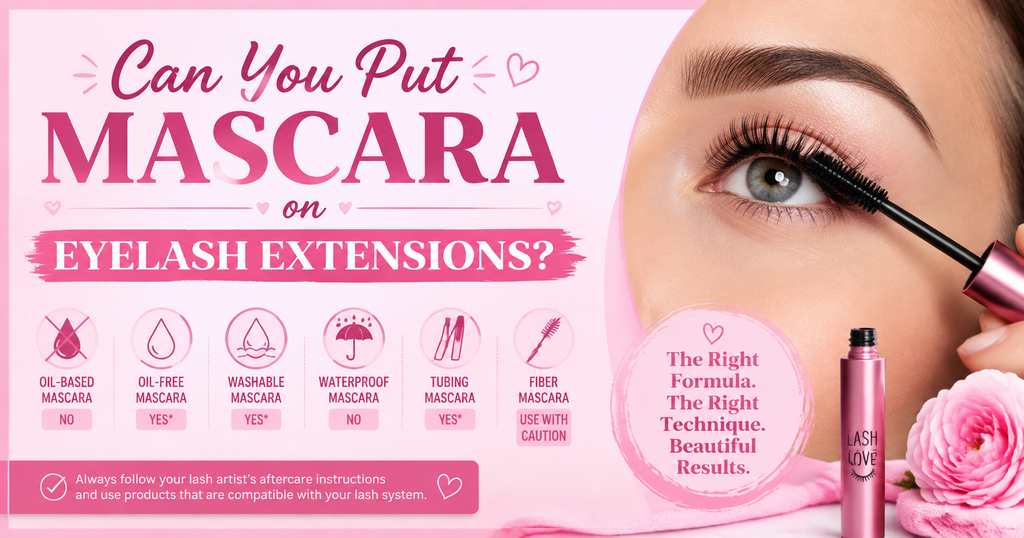
Quick Answer: Can You Wear Mascara With Eyelash Extensions
You can wear mascara with some eyelash extensions, but it is usually unnecessary and is not suitable for every type of lash set. Some professional lash systems allow a small amount of mascara that is specifically formulated to be compatible with their extensions.
Classic eyelash extensions are generally the most suitable type if an approved mascara is used, while mascara should generally be avoided on hybrid and volume extensions because it can make the fine extension fibers clump together and reduce the open, fluffy appearance of the fans.
Because lash adhesives and extension systems are not all formulated or maintained in exactly the same way, the safest approach is to use mascara only when it is compatible with your particular lash system and to follow the aftercare instructions provided by your lash artist or extension manufacturer.
No, You Should Generally Not Put Oil-Based Mascara on Eyelash Extensions Because
Oil-based mascara is generally best avoided with eyelash extensions when the adhesive system requires oil-free aftercare. Oils and oil-rich cosmetics that repeatedly contact the lash attachment area may interfere with the retention of some extension adhesives, which can contribute to extensions loosening or shedding earlier than expected.
However, oil does not weaken every eyelash-extension adhesive. For this reason, clients should follow the aftercare instructions for the specific adhesive used by their lash artist rather than assuming that every oil-based mascara will affect every set of eyelash extensions in the same way.
Yes, You May Be Able to Put Oil-Free Mascara on Eyelash Extensions Because
Oil-free mascara may be compatible with some eyelash extensions, but an oil-free label alone does not make a mascara suitable for every lash set.
Mascara compatibility depends on the extension technique, the adhesive system, the mascara formulation, the amount of product applied, and the amount of friction required during removal.
For these reasons, an oil-free mascara should not automatically be treated as safe for all eyelash extensions; the mascara should also be compatible with the specific extensions and adhesive being worn.
Choose a Lash-Extension-Compatible Formula When Possible
When mascara is permitted with a particular lash set, choose a formula specifically identified as compatible with that eyelash-extension system rather than relying only on marketing terms such as “oil-free” or “water-based.”
Professional lash brands formulate compatible cosmetics around the requirements of their own extension and adhesive systems.
Some manufactures state that its extension-compatible cosmetics are formulated for use with its adhesives and extensions, while Some manufactures also describe its eyelash-friendly cosmetics as specifically formulated for compatibility with its lash system.
Using a mascara approved for the specific lash system reduces uncertainty about formula compatibility and allows the wearer to follow the application and cleansing instructions designed for that extension system.
Which Types of Eyelash Extensions Can You Wear Mascara With
Whether you can wear mascara depends largely on the type of eyelash extensions you have and the aftercare rules for the specific lash system used.
Classic extensions are generally the most compatible with an approved extension-safe mascara because each classic extension is applied individually to a natural lash, while hybrid and volume techniques include multi-fiber fans that can lose their separation when coated with mascara.
Some manufactures specifically advise clients not to apply mascara to extensions created with its Hybrid or Volume techniques because mascara can make the extensions clump together or lose volume.
Because proprietary lash systems can have different product-compatibility rules, you should still follow the mascara guidance provided for your particular extensions rather than assuming that one rule applies to every lash system.
Classic Eyelash Extensions
If you have classic eyelash extensions, you may be able to use a small amount of mascara when your lash system specifically permits it.
Classic extensions use a one-to-one application technique, meaning one extension is attached to one natural lash, so there are no multi-fiber volume fans for mascara to bind together.
This individual-lash structure makes classic sets more compatible with mascara than hybrid or volume sets.
Some manufactures also formulates its extension-safe mascara specifically for classic extensions and instructs wearers to apply the product only to classic extension tips rather than to hybrid or volume sets.
You should therefore use mascara on classic extensions only when the formula is approved for extensions and compatible with the lash system you are wearing.
Hybrid Eyelash Extensions
If you have hybrid eyelash extensions, mascara is generally best avoided because a hybrid set combines individual classic extensions with volume fans.
Although mascara may coat the individual classic extensions without immediately changing their structure, the same mascara can bind the fine fibers within the volume portions of the hybrid set together, reducing the separation and fullness those fans are designed to create.
If your hybrid set belongs to a proprietary system with different aftercare instructions, follow that system’s guidance rather than applying a general mascara rule.
Volume and Mega-Volume Eyelash Extensions
If you have volume eyelash extensions, you should generally avoid coating them with mascara because volume techniques use several fine extension fibers arranged as a fan on a natural lash rather than a single extension.
Mascara can coat those separate fibers and make them stick together, which reduces the open, fluffy appearance of the volume fan.
The same concern commonly applies to mega-volume sets, which also use multi-fiber fans, but the rule is not universal across every proprietary system. Some manufacturers also state that its own adhesive system permits its extension-friendly mascara for touch-ups and discusses that compatibility in the context of its high-volume and mega-volume extensions.
If you wear volume or mega-volume lashes, you should therefore avoid mascara unless the manufacturer or lash professional responsible for your specific extension system explicitly confirms that a compatible mascara can be used.
Situations That Lead You to Avoid Mascara
Oil May Affect the Lash Extension Bond and Cause Premature Shedding
If your eyelash-extension system requires oil-free aftercare, oil-based mascara can create a retention problem because oily cosmetic products may interfere with the adhesive bond used by that particular system.
Some manufactures state that excessive facial oils and other incompatible cosmetics contacting its extended lashes can weaken adhesive bonds and contribute to premature extension loss.
This effect is not identical across every adhesive formulation, however; NovaLash specifically describes its proprietary adhesive as oil-friendly and resistant to breakdown from oil-based cosmetics.
The risk from oil-based mascara therefore depends on the adhesive system holding your extensions rather than on oil being universally harmful to every eyelash-extension bond.
Not Every Mascara Is Compatible With Eyelash Extensions
An ordinary mascara may not be compatible with your eyelash extensions because most mascaras are not formulated around the requirements of a specific extension adhesive or lash system.
Professional lash companies therefore distinguish between standard eye cosmetics and formulas developed specifically for extensions.
This product-specific compatibility means that the fact a product is simply labeled “mascara,” “oil-free,” or “water-based” does not by itself establish that the formula is suitable for your particular eyelash extensions.
Mascara Adds Weight and Can Make Extensions Feel Bulky
Mascara works by depositing cosmetic material onto the lash surface, with common formulations using ingredients such as pigments, waxes, resins, and other film-forming materials to create thickness and definition.
When you apply mascara over eyelash extensions, that additional material also coats the extension fibers, and repeated or heavy coats increase the amount of product sitting on the lashes.
The accumulated coating can make extensions feel heavier and appear thicker or bulkier than their original lightweight finish.
Professional extension aftercare guidance also cautions against excessive mascara application, supporting the concern that unnecessary layers of mascara add avoidable product buildup to an extension set.
Removing Mascara Can Put Extra Stress on Lash Extensions
Removing mascara can place additional mechanical stress on eyelash extensions because taking cosmetic residue off the lash fibers requires more handling than leaving the extensions bare.
Repeated wiping, rubbing, tugging, picking, or pulling during mascara removal can transfer physical force to both the extensions and the natural lashes supporting them.
The removal process therefore becomes a concern when mascara requires enough manipulation to repeatedly disturb the attached extensions.
Mascara May Smudge When You Sweat
Some washable or non-waterproof mascaras may smudge when sweat or moisture reaches the lashes because these formulas are not necessarily designed to resist water and perspiration.
When mascara smudges on eyelash extensions, the softened pigment can transfer from the coated lashes onto the surrounding eye area, leaving dark marks and making the lash look appear less clean or defined.
The extent of smudging depends on the individual mascara formula, so sweating does not cause every non-waterproof mascara to behave in exactly the same way.
Mascara Can Clump Your Lash Extensions
Mascara can make separate eyelash-extension fibers stick together because the mascara coating can collect across neighboring fibers instead of leaving each extension visually separated.
This clumping is particularly relevant to hybrid and volume lash applications, where maintaining separation between the fine extension fibers is part of the intended full, soft appearance.
As more fibers become coated and joined by mascara, the lash set can lose its defined separation and appear more grouped or uneven instead of retaining the original fan-like finish.
You Have Volume, Hybrid, or Mega-Volume Extensions
Mascara is generally unsuitable for volume, hybrid, and mega-volume extensions because these lash styles contain multi-fiber fans whose appearance depends on the individual extension fibers remaining separated.
Hybrid sets combine individual classic extensions with volume fans, while volume and mega-volume techniques use multiple fine extensions arranged together to create greater density.
When mascara coats these fine fibers, the product can bind neighboring extensions together and reduce the separation that gives the fans their intended open, voluminous appearance.
The same structural concern applies to mega-volume sets that rely on multiple lightweight fibers within each fan, although mascara compatibility can vary with proprietary lash systems.
Your Lash Artist or Adhesive Manufacturer Says Not to Use Mascara
Mascara should be avoided when the lash artist or manufacturer of your specific extension system instructs you not to use it, because eyelash-extension systems do not all have identical cosmetic-compatibility requirements.
Some manufactures prohibit mascara on its Hybrid and Volume applications, while others state that its proprietary adhesive system permits its own extension-friendly touch-up mascara.
These different manufacturer instructions demonstrate why generic mascara advice cannot be applied equally to every lash set.
When the aftercare instructions for your particular extensions prohibit mascara, using mascara goes against the product and maintenance requirements established for that specific lash system.
Your Eyes or Eyelids Are Irritated
If your eyes are irritated or the skin around your eyelids is inflamed, applying mascara adds another cosmetic product to an already sensitive area and may worsen irritation.
The U.S. Food and Drug Administration advises consumers to stop using any eye cosmetic that causes irritation and to avoid eye cosmetics completely when an eye infection is present or the surrounding skin is inflamed until the area has healed.
The American Academy of Ophthalmology also notes that eye makeup can contribute to irritation, particularly when cosmetic material reaches the eye surface.
For this reason, redness, swelling, soreness, persistent itching, or an active eye infection are situations in which mascara should be left off rather than applied over or around irritated eyes.
Factors That May Lead You to Use Mascara
Temporarily Enhance Your Look
If you have classic eyelash extensions and your lash system permits mascara, a compatible mascara can temporarily make your lashes look darker, thicker, and more defined.
Some manufactures formulate its extension-compatible mascara to add color, definition, length, and volume to Classic Single-Layer extensions and specifically permits its use on that extension type.
A light mascara coating can also make the remaining natural lashes appear more visually integrated with the extensions, creating a more uniform lash-line appearance for occasions when you want additional definition.
The enhancement is cosmetic and temporary: mascara changes the appearance of the lashes only while the product is being worn.
Mascara Can Temporarily Revive a Sparse-Looking Classic Set
If your classic lash set has begun to look sparse as extensions naturally shed, compatible mascara can temporarily make the remaining lashes appear darker and more defined, reducing the visual prominence of small gaps before your next fill.
Lash extensions gradually become less dense as the natural lashes supporting them shed, which is why extension sets can start to look sparse between maintenance appointments.
Experts similarly identified a sparse-looking set before a refill as one situation in which mascara may temporarily improve the appearance of the remaining lashes.
Mascara does not replace extensions that have already shed, however, so its effect is limited to temporarily enhancing the lashes that remain.
Colored Mascara for a Different Look
If you want to temporarily change the appearance of your eyelash extensions, a colored mascara that is explicitly compatible with your lash-extension system can add a different shade without changing the extensions themselves.
Colored mascara deposits visible pigment onto the lashes, allowing shades such as brown, blue, or other colors to alter the overall lash look only while the mascara is being worn.
Because mascara compatibility varies between extension systems, the color of the mascara does not determine whether the formula is appropriate for your extensions; the colored formula itself still needs to be compatible with the lash system.
You Want More Definition for a One-Time Event
If you want a slightly stronger lash definition for a special event, a small amount of extension-compatible mascara may temporarily intensify an appropriate classic lash set.
Extension-compatible mascaras are designed to add visible color and definition to the lashes.
This temporary cosmetic effect can make your lashes appear more pronounced for an occasion without changing the underlying extension set itself.
Use Washable Mascara
If your eyelash-extension system allows mascara, choose a washable formula that can be removed without persistent rubbing, tugging, or pulling at the extensions.
Easy removal matters because repeated mechanical handling around attached extensions can interfere with retention.
Some manufactures specifically formulate its extension mascara as water-soluble, while others describe its extension-compatible mascara as easy to remove with the cleanser designed for its system.
A washable formula therefore makes more sense for compatible extensions than a mascara that requires substantial effort to remove.
Use Water-Based Mascara
A water-based, extension-compatible mascara is a commonly recommended option when your particular lash system permits mascara.
Some manufactures recommend a water-based extension-safe formula for compatible classic extensions, and its own extension mascara is specifically formulated as water-based.
However, the term “water-based” does not by itself confirm that a mascara is appropriate for your extensions.
The complete formula still needs to be compatible with the adhesive and extension system you are wearing, so water-based mascara should be treated as one compatibility feature rather than a universal guarantee.
Use a Mascara Wand That Separates the Lashes
When you apply compatible mascara to eyelash extensions, a wand designed to separate the lashes and distribute the product evenly can help you maintain a cleaner, more controlled application.
Some manufactures describe the brush supplied with its extension-friendly mascara as a hollow-fiber brush designed to lift and separate lashes, while its separate extension brush is designed to comb through natural lashes and extensions evenly.
A separating brush is therefore a better-supported consideration than assuming that a mascara wand is suitable simply because its bristles are widely spaced.
Avoid Using Oil-Based Mascara
Avoid oil-based mascara when the aftercare instructions for your eyelash-extension system require oil-free cosmetics.
Some extension systems warn that oils and incompatible cosmetic products around the lashes can interfere with adhesive retention.
Oil sensitivity is not universal, however, because some proprietary adhesives are specifically formulated to tolerate oil; NovaLash states that its adhesive system permits oil-based makeup.
For this reason, oil-based mascara should be avoided whenever the specific adhesive manufacturer’s aftercare guidance identifies oil as incompatible with the extension bond.
Avoid Using Waterproof Mascara
Avoid waterproof mascara on eyelash extensions because its resistance to water can make the product more difficult to remove from the lash fibers without additional cleansing and manipulation.
Some manufactures specifically list waterproof mascara and other waterproof cosmetics used on or near extended eyelashes among the factors that can compromise extension longevity.
Some manufactures also recommends water-based, extension-compatible mascara instead of waterproof formulas and notes that its washable extension mascara is designed to come off without harsh rubbing.
The concern with waterproof mascara is therefore primarily the more demanding removal process and the extra handling that stubborn product can require around attached extensions.
Use Mascara Mainly With Classic Lash Extensions
If you want to wear mascara with eyelash extensions, classic extensions are generally the most suitable type when your specific lash system permits mascara.
Classic sets use individual extensions rather than multi-fiber fans, so compatible mascara can be applied without collapsing the fan structure found in other techniques.
You should therefore limit mascara use to an appropriate classic set unless the manufacturer of your particular extension system provides different guidance.
Don’t Wear Mascara Too Often
Keep mascara use occasionally rather than making it part of your everyday routine while wearing eyelash extensions.
Frequent mascara wear creates repeated application and removal cycles around the attached extensions, so limiting how often you use mascara reduces unnecessary product handling.
Mascara is therefore better reserved for times when you genuinely want additional definition rather than being applied automatically every day.
Use Mascara Sparingly When a Classic Set Looks Sparse
If your compatible classic lash set begins to look sparse as some extensions naturally shed, a small amount of extension-safe mascara can temporarily make the remaining lashes look more defined until your next fill.
Natural lash shedding gradually reduces the density of an extension set, so mascara in this situation serves only as a temporary cosmetic touch-up; it does not replace the extensions that have already shed or restore the fullness provided by a professional fill.
Apply Mascara to the Tips, Not the Roots
When your lash-extension system permits mascara, apply the product only to the tips of compatible classic extensions rather than coating the lashes from the roots upward.
Limiting mascara to the tips also concentrates the cosmetic effect on the visible ends of the extensions without unnecessarily coating the base of the lash set.
Use an Extension-Compatible Cleanser to Remove Mascara
Use a cleanser specifically formulated or approved for eyelash extensions when removing mascara from your lash set. An extension-compatible cleanser is designed to remove makeup and residue while remaining suitable for the adhesive system it is intended to accompany.
Some manufactures, for example, instruct users to remove its extension-safe mascara with its TLC Lash Cleanser or another extension-safe remover, and the company describes its TLC Cleanser as formulated to remove makeup and buildup without affecting its lash adhesive bond.
Because adhesive systems can differ in their compatibility requirements, an extension-compatible cleanser is a more accurate choice than assuming that every cleanser labeled simply “oil-free” will suit every lash system.
Use a Light Hand and Avoid Heavy Layers
Apply mascara lightly rather than building multiple heavy layers on your eyelash extensions.
A lighter application limits the amount of cosmetic product deposited on the extension fibers while still providing the intended definition.
Avoid Tubing Mascara Unless It Is Confirmed Extension-Compatible
Do not assume that a tubing mascara is suitable for eyelash extensions simply because the formula can be removed with warm water.
Tubing mascaras form flexible polymer tubes around individual lashes, and removal typically involves softening those tubes with warm water and then gently sliding them down and off the lashes.
Some lash-extension guidance therefore advises against tubing formulas because this removal method involves physically manipulating the coated lashes.
However, tubing mascara does not automatically damage or grip eyelash-extension adhesive, and I found no reliable evidence supporting that universal claim.
Unless your lash artist or extension-system manufacturer specifically confirms that a particular tubing formula is compatible with your extensions, it is better not to treat the formula as extension-safe.
Avoid Fiber Mascara Unless It Is Confirmed Extension-Compatible
Fiber mascara contains small fibers that adhere to the lashes to create additional length or volume, so the formula can leave more material among eyelash extensions than a conventional smooth mascara coating.
Because reliable evidence does not show that every fiber mascara automatically damages extension adhesive, you should avoid making that assumption; the practical concern is the potential for fibers to become entangled within the lash set and require extra manipulation during cleansing.
Unless a particular fiber mascara is explicitly approved for your extension system, it is safer not to use it on the extensions.
Let the Lash Adhesive Complete Its Recommended Cure Period First
Before applying mascara after a fresh eyelash-extension appointment, follow the post-application cure and cosmetic-use timeframe specified for the adhesive system used on your lashes rather than relying on a universal 24-hour rule.
The different manufacturer instructions show that the appropriate waiting period depends on the adhesive system rather than on one fixed timeframe that applies to every set of eyelash extensions.
Follow Your Lash Artist’s Aftercare Instructions
Follow the aftercare instructions given for your specific eyelash-extension system, because different adhesives and extension products can have different restrictions on mascara, cosmetics, moisture, and other exposures.
These differences mean that generic online advice cannot reliably account for every adhesive formulation.
Your lash artist’s instructions, when based on the adhesive and products actually used during your appointment, provide the most relevant aftercare requirements for your particular set.
Keep the Mascara Wand and Eye Area Clean
Keep your hands, mascara applicator, and eye area clean whenever you apply mascara around eyelash extensions.
The U.S. Food and Drug Administration advises washing your hands before applying eye cosmetics, keeping eye-area instruments and cosmetic containers clean, and never sharing eye cosmetics because another person’s microorganisms can contaminate the product.
The FDA also notes that eye cosmetics have a relatively limited usable life and reports that manufacturers commonly recommend discarding mascara about two to four months after purchase; separate FDA shelf-life guidance notes that some industry experts recommend replacement after about three months.
Clean application practices help reduce unnecessary contamination around the eyes while you are wearing mascara with eyelash extensions.
How to Apply Mascara to Lash Extensions
Step 1: Confirm That Your Extension Type Allows Mascara
Before applying mascara, confirm that your specific eyelash-extension type and system permit mascara use. Some classic extension systems allow a compatible mascara, while other techniques have stricter restrictions. Use mascara only when the guidance for your particular lash set allows it.
Step 2: Make Sure the Recommended Aftercare Period Has Passed
Follow the post-application timeframe provided for the adhesive system used on your lashes before applying mascara or other eye cosmetics. There is no single waiting period that applies to every eyelash-extension adhesive. Apply mascara only after the relevant aftercare period for your lash system has passed.
Step 3: Remove Excess Mascara From the Wand
Before the mascara wand touches your extensions, remove any obvious excess product from the brush so you can apply a controlled amount rather than depositing a thick layer at once. Keeping the wand lightly loaded gives you better control over how much mascara reaches the extensions.
Step 4: Apply a Light Coat From the Middle Toward the Tips
Apply compatible mascara from approximately the middle of the classic extensions toward the tips, using gentle upward strokes rather than starting at the attachment area. Keep each stroke light and controlled so the mascara remains concentrated on the portion of the extension intended to be coated.
Step 5: Avoid Multiple Heavy Coats
Keep the mascara application light rather than building several thick layers on your extensions. Follow the coat recommendation for the compatible mascara you are using instead of repeatedly layering product for additional coverage.
Step 6: Let the Mascara Set Without Rubbing or Pressing the Extensions
After your final coat, leave the mascara-coated extensions undisturbed while the formula sets instead of touching, rubbing, or pressing the lashes.
General mascara instructions allow the applied formula to dry after application, while eyelash-extension aftercare guidance specifically identifies friction, eye rubbing, picking, and pulling as actions that can interfere with extension retention.
Allowing the finished application to set without unnecessary physical contact keeps this final step gentle and controlled.
How to Remove Mascara From Lash Extensions
Use the Cleanser Recommended for Your Extension System
Use a cleanser that is specifically approved for your eyelash-extension system when removing mascara. Different adhesive systems can have different cosmetic and cleanser compatibility requirements, so a general makeup remover should not automatically be assumed to be suitable for your extensions.
Follow the cleanser recommendation provided for the particular extensions and adhesive you are wearing.
Loosen the Mascara Gently
Work the recommended cleanser gently through the mascara-coated extensions instead of immediately scrubbing at dried product. Gentle cleansing allows the mascara and cleanser to be worked together without relying on forceful rubbing to remove the cosmetic coating.
Clean in the Direction of the Lashes
Move your cleansing tool along the natural direction of the extensions, from the base toward the tips, rather than repeatedly dragging the lashes sideways.
Following the direction of the lashes keeps the cleansing movement controlled and consistent with professional extension-care instructions.
Never Pick, Rub, or Pull Mascara From the Extensions
Do not remove dried mascara by picking at individual extensions, rubbing the lash line, or pulling product from the lash fibers.
Mascara that does not come away during normal cleansing should therefore be worked through gently with the appropriate cleanser rather than physically peeled or pulled from the extensions.
Rinse and Dry According to Your Lash Artist’s Instructions
After cleansing, rinse away the loosened mascara and cleanser according to the aftercare instructions for your extension system. Drying recommendations can vary between systems; Follow the drying method recommended for your particular lash set.
Brush the Extensions Gently After They Are Dry
Once your eyelash extensions are dry, gently groom them with a clean lash styling wand or spoolie to restore their separation and direction. Keep the brushing light and controlled so the final step simply returns the cleaned extensions to their intended arrangement.
What If You Already Put the Wrong Mascara on Your Extensions
If you have already applied an incompatible, waterproof, or difficult-to-remove mascara to your eyelash extensions, do not try to fix the problem by aggressively rubbing, picking, peeling, or pulling the mascara from the extension fibers.
Work the approved cleanser through the mascara gently and give the product time to loosen rather than trying to strip dried mascara from individual extensions.
If stubborn mascara remains after appropriate cleansing, especially a resistant waterproof formula, contact your lash professional for guidance instead of repeatedly manipulating the extensions in an attempt to remove every trace yourself.
Can You Put Mascara on Your Bottom Lashes With Eyelash Extensions
Yes, you can generally apply mascara to your natural bottom lashes while wearing upper eyelash extensions because the mascara is being applied to the lower natural lashes rather than directly coating the upper extension fibers.
A washable, easy-to-remove formula is the more practical choice because bottom-lash mascara still needs to be removed close to the upper lash line.
Experts similarly recommend avoiding difficult-to-remove waterproof formulas on the bottom lashes because the stronger removal process can bring additional product and manipulation close to the upper extensions.
Keep the bottom-lash mascara from transferring onto the upper extensions and remove it carefully without aggressively rubbing the upper lash line.
Can You Still Do Eye Makeup With Lash Extensions
Lash extensions can change the way you approach your usual eye makeup routine, making it natural to wonder what is still possible. If you want a clearer understanding before doing your makeup, read our complete guide on Can You Still Do Eye Makeup With Lash Extensions.
Can You Wear Eyeliner With Eyelash Extensions
Eyeliner is often an important part of an eye makeup look, but having eyelash extensions can make you question whether you can continue using it as usual. To explore this topic in more detail, read our guide on Can You Wear Eyeliner With Eyelash Extensions.
Conclusion
You can wear mascara with some eyelash extensions, but compatibility depends on the extension type, adhesive system, mascara formula, and aftercare instructions.
Classic extensions are generally the most suitable for a small amount of approved mascara, while hybrid, volume, and mega-volume sets are usually better left mascara-free.
If you do use mascara, choose a compatible, easy-to-remove formula, apply it lightly, and avoid unnecessary buildup or aggressive removal.
Follow the guidance provided for your specific lash system, especially after a fresh application.
If irritation develops or stubborn mascara remains on the extensions, stop adding more product and seek appropriate advice from your lash professional before manipulating the lash set further yourself.