
Published On: 20 August 2026
Eyelash extensions already come with a preset curl, so reshaping them after application needs judgment. A mechanical eyelash curler can clamp, bend, snag, or pull extensions that are bonded to natural lashes, which is why safer alternatives deserve attention.
In this guide, you will learn how choosing the right curl style, gentle brushing, regular fills, proper aftercare, and careful sleeping habits can help maintain the shape of your set.
You will also learn when a heated eyelash curler may be appropriate, how to use heat cautiously, and when to stop.
If your extensions lose their curl, look uneven, or become uncomfortable, keep reading to learn what you can safely do at home and when professional help is the better choice.
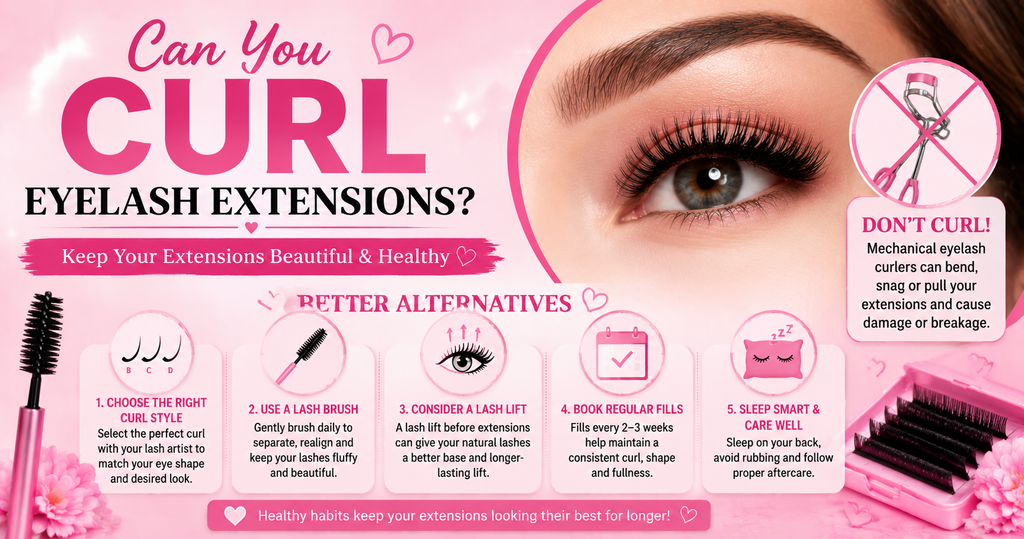
You Should Not Curl Eyelash Extensions With a Mechanical Eyelash Curler
You should avoid using a mechanical eyelash curler on installed lash extensions because the tool applies concentrated clamping pressure to extensions that are bonded to individual natural lashes.
When the curler closes over the lash line, its pad can bend the preset extension shape or trap individual fibers between the clamp surfaces.
If a trapped extension is pulled as you lift or release the curler, that traction is transferred to the natural lash and its adhesive attachment.
The mechanical stress can leave an extension kinked or misaligned and may contribute to premature detachment. A stronger snag can also pull or break the natural lash carrying the extension.
Professional extension aftercare therefore advises against mechanical curlers, while ophthalmology guidance also recognizes eyelash curlers as a potential source of physical lash damage.
Better Alternatives to Curling Your Lash Extensions
Choose a Lash Extension Curl Style That Matches Your Preferences
Choose your preferred lash extension curl during the consultation instead of trying to reshape the extensions after application.
Professional lash extensions are available in different preset curvatures, so your lash artist can create a softer lift or a more pronounced curl from the start.
Your lash artist should also consider the direction and curvature of your natural lashes because the same extension curl can sit differently on straight, upward-growing, or downward-pointing lashes.
Eye shape and the look you want also influence which curvature creates the intended result. Professional lash systems specifically use different extension curvatures to customize lift and eye shape, while extension sets can also be selected according to curl, length, and thickness.
Choosing the appropriate eyelash extensions curl types before application therefore gives you the desired shape without adding unnecessary mechanical stress to an installed set.
Use a Lash Brush to Groom and Realign Your Lash Extensions
Use a clean lash brush to separate and realign extensions that look crossed, tangled, or uneven.
Gentle brushing can restore a fuller and more lifted appearance by helping individual extensions sit in their intended direction.
A spoolie does not create a new curl in the extension fiber, so you should use it for grooming rather than reshaping the preset curl. Professional lash-care guidance supports brushing extensions to keep them separated, fluffy, and visually well aligned.
Brush with light pressure and stop if the spoolie catches on an extension. Pulling through a snag can place unnecessary traction on the extension and the natural lash supporting it.
Consider a Lash Lift Before Getting Lash Extensions
Consider a professional lash lift before extensions if your natural lashes grow very straight or downward and do not align well with the extension curl you want.
A lash lift changes the curvature of your natural lashes by chemically modifying and reorganizing bonds within the lash hair, allowing the lashes to set in a more lifted position.
The lifted natural lashes can provide a different foundation for extension placement and may reduce the desire to mechanically curl the finished set afterward.
However, a lash lift is a chemical service, so the technician must assess your natural lashes for signs of weakness or previous overprocessing before combining treatments. Excessive chemical processing can contribute to dryness or breakage.
The timing and preparation should also follow the specific lift system because residual lifting solutions or conditioning products can interfere with how extension adhesive behaves.
If you are somewhere in Dubai, you can book premium quality home lash lift Dubai by Pink Beauty Salon.
Book Regular Fills to Maintain a Consistent Curl and Shape
Book regular fills so your lash artist can restore the overall curl pattern as natural lashes grow and shed. Each extension leaves the set when the natural lash supporting it sheds, which gradually creates gaps and makes the original shape look less uniform.
During an infill, the lash artist replaces missing extensions and works around the remaining set to restore its intended styling.
Gaps commonly become noticeable around the 2–3 week mark, although your ideal refill schedule depends on your natural lash cycle, retention, aftercare, and lifestyle.
Regular fills therefore maintain the appearance of an even, lifted set without requiring you to reshape the extensions with a curler.
If you are somewhere in Dubai, you can book premium quality home lash extensions Dubai by Pink Beauty Salon.
Avoid Using Mascara When It Is Not Necessary
Skip mascara when your lash extensions already provide the darkness and fullness you want. Mascara coats individual extensions and can make separated fibers stick together, which reduces the clean definition of the installed set.
Waterproof mascara is particularly unsuitable for many extension systems because its resistant film requires more intensive removal, which can increase rubbing and manipulation around the bonded lashes.
Professional extension aftercare specifically advises avoiding waterproof mascara and excessive mascara application.
If you need extra definition near a refill appointment, use only a mascara for eyelash extensions that the extension manufacturer or your lash artist confirms is compatible with the adhesive system.
Extension-specific mascaras are available in water-soluble formulas that are designed to be easier to remove from installed lashes.
Follow Proper Lash Extension Aftercare
Good lash extension aftercare includes keeping your lashes clean, avoiding unnecessary rubbing or pulling, brushing them gently with a clean spoolie, and being careful around the eye area.
Following a consistent routine can help keep your extensions looking tidy between appointments. If you want more detailed guidance, read our complete article on EyeLash Extension Aftercare.
You May Use a Heated Eyelash Curler Only If Your Lash Extension System Allows It
First Check Whether Your Lash Extension System Allows Heat
Check the aftercare instructions for your exact lash extension system before switching on a heated curler. Ask your lash artist whether heated styling is compatible with the extension fibers and adhesive used in your set.
Do not assume that a tool designed for natural lashes or another type of false-lash system is suitable for your extensions.
Professional aftercare protocols can specifically prohibit both mechanical and heated curlers, so system-specific guidance should take priority over general curling advice. If your manufacturer or lash artist advises against heat, do not use the heated curler.
If the instructions provide no clear guidance, avoiding heat is the safer option until compatibility can be confirmed.
Start With the Lowest Practical Heat Setting
If your lash extension system specifically allows heated styling, start with the lowest temperature setting that can produce the intended effect.
Lower heat reduces unnecessary thermal exposure to the extension fibers and the delicate eye area.
Do not increase the temperature simply to create a stronger curl faster. Increase the setting only when the manufacturer’s instructions permit it and the lowest setting produces no useful change.
The American Academy of Ophthalmology also advises checking the temperature of heated eyelash-curler settings and beginning with the lowest temperature possible.
Test the Temperature Before Bringing the Tool Near Your Eye
Check the heated curler before placing it close to your lashes or eyelid. Allow the tool to reach the selected setting and follow its temperature indicator or manufacturer-recommended testing method before use.
If the manufacturer permits a skin test, briefly check the tool on your hand first to identify obviously excessive heat, but do not assume that comfortable heat on your hand will be equally comfortable near the eye.
The eyelid is a delicate area, so the heated surface should never touch the eyelid while you curl your lashes.
Use Short, Controlled Applications
If your lash extension system permits heated styling, apply heat in short and controlled passes instead of holding the curler against one section of lashes for an extended period.
Move the heated surface gently through the permitted area and follow the contact time specified by the tool manufacturer.
Prolonged or repeated exposure adds unnecessary heat without guaranteeing a better curl. Stop once the lashes reach the intended shape rather than repeatedly reheating the same fibers.
The American Academy of Ophthalmology also advises using the lowest possible temperature with heated eyelash curlers and taking care to avoid excessive heat near the eye.
Some professional extension systems prohibit heated curlers altogether, so their specific aftercare instructions should take priority.
Work From the Mid-Length Toward the Tips, Not Directly on the Adhesive Bond
Keep the heated curler away from the lash roots and the points where the extensions are bonded to your natural lashes.
If your extension system specifically permits heated styling, work gently from the mid-length toward the tips rather than concentrating heat at the attachment area.
This placement also keeps the heated surface farther from the eyelid, which reduces the chance of accidental skin contact. Use light upward passes instead of pressing the tool against the lashes or holding it stationary near the lash line.
Stop immediately if the extensions begin to kink, flatten, or change shape unexpectedly. The American Academy of Ophthalmology advises keeping heated eyelash curlers from becoming excessively hot and avoiding contact with the eyelid.
Keep the Heated Curler Away From the Adhesive Bond and Eyelid
Keep the heated curler away from the point where each extension is bonded to the natural lash. Direct heat at this attachment area adds unnecessary thermal exposure to the adhesive connection.
Some professional extension systems specifically warn that heated curlers can weaken adhesive bonds and contribute to premature extension loss. Keeping the heated surface away from the lash root also increases the distance between the tool and your eyelid.
The American Academy of Ophthalmology warns that excessive heat around the eye can damage the thin eyelid skin. If you cannot keep the heated surface safely separated from the bond and eyelid, do not continue using the tool.
Stop if the Extensions Bend, Kink, Soften, or Become Uncomfortable
Stop using the heated curler if an extension begins to kink, flatten, soften, or change shape unexpectedly. These changes indicate that the heat is altering the extension fiber rather than producing a controlled adjustment.
This concern is particularly relevant to PBT-based extensions because PBT is a thermoplastic whose mechanical behavior changes as temperature rises, well before the polymer reaches its melting point.
Stop immediately if the heat also causes burning, pain, or unusual discomfort around your lashes or eyelid. Continuing after either fiber deformation or discomfort can increase the chance of damaging the installed set or exposing the delicate eye area to excessive heat.
What to Do if Your Lash Extensions Lose Their Curl
If your lash extensions start looking less curled or uneven, first check whether the fibers are simply crossed, tangled, or sitting out of alignment.
Gently brush clean, dry extensions with a clean lash brush to separate the fibers and return them to their intended direction.
Do not repeatedly clamp, pull, or manipulate the installed extensions in an attempt to restore their original curve, because additional mechanical force can disturb the extensions and the natural lashes supporting them.
Professional aftercare guidance specifically advises against pulling, picking, and curling installed extensions. If brushing does not restore the appearance, the problem may be the overall shape of the aging set rather than a curl that you can safely recreate at home.
Natural lash shedding gradually creates gaps, while remaining extensions move outward as their supporting natural lashes grow.
A professional fill allows missing or poorly positioned extensions to be replaced and the intended lash design to be restored. Professional maintenance guidance also recommends scheduling refills according to your individual retention and lash cycle.
When to Ask Your Lash Artist for Help
Ask your lash artist to inspect extensions that remain visibly kinked, twisted, loose, or repeatedly point in the wrong direction after gentle grooming. Do not pull a misdirected extension or try to force it back into position yourself.
Excessive tugging can place traction on both the extension and the natural lash attached to it, while professional aftercare specifically advises against picking and pulling installed extensions.
A lash artist can determine whether the affected extension should be removed, replaced, or corrected during maintenance without unnecessarily manipulating the rest of the set.
Persistent discomfort should not be treated as a styling problem. If you develop eye pain, redness, tearing, swelling, or a foreign-body sensation, seek prompt professional eye care rather than waiting for a lash appointment.
Conclusion
Curling eyelash extensions safely depends on the tool and the extension system you are wearing. Avoid mechanical eyelash curlers because their clamping action can bend, snag, or pull installed extensions and the natural lashes supporting them.
Instead, maintain the intended shape through the right preset curl, gentle brushing, regular fills, and consistent aftercare.
If your lash system specifically allows heated styling, use the lowest practical heat, short applications, and keep the tool away from the adhesive bond and eyelid.
Stop if the fibers kink, soften, or feel uncomfortable. When extensions remain twisted, loose, painful, or difficult to realign, let your lash artist assess and correct the set professionally and safely.