

Published On: 05 Nov 2025
Bikini waxing is one of the most popular methods for achieving smooth, long-lasting results in the intimate area. However, choosing the right type of wax plays a crucial role in ensuring both comfort and effectiveness.
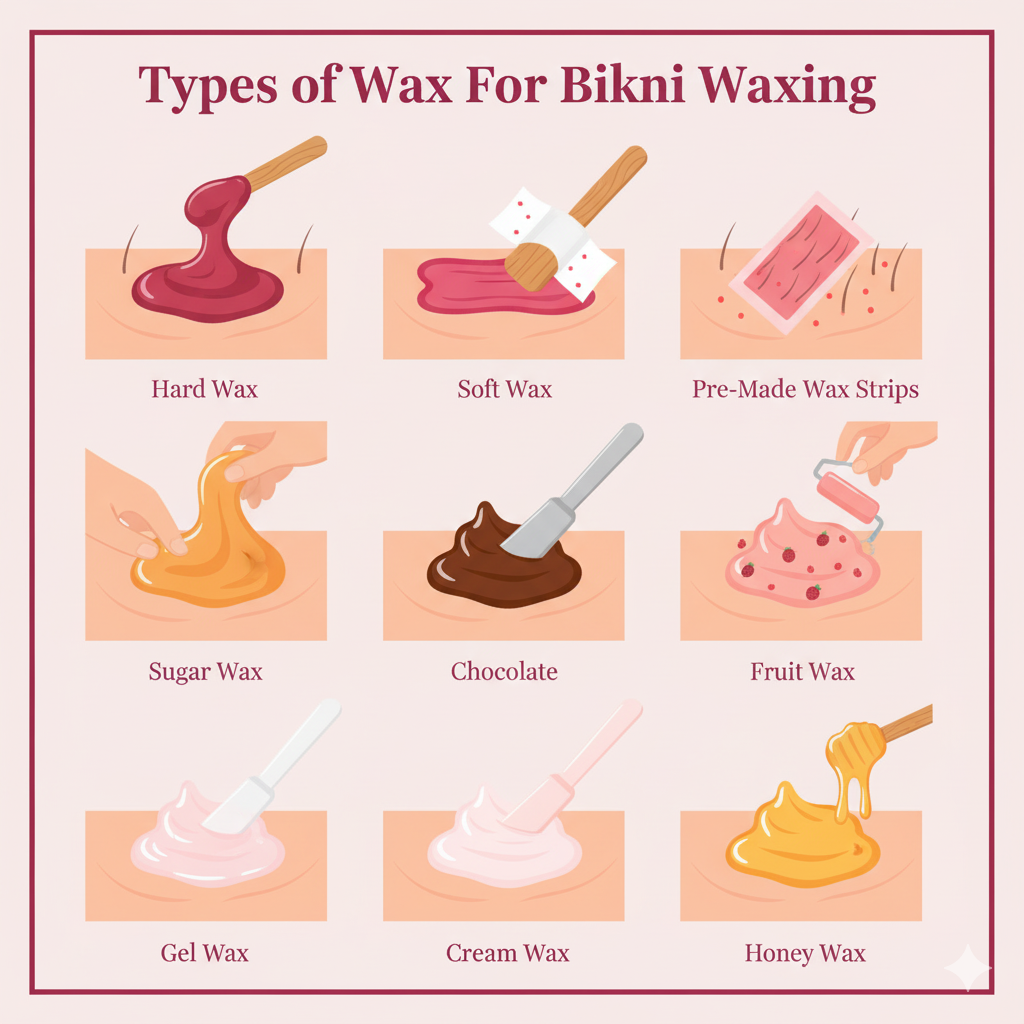
In this article, we’ve explored nine major types of wax used for bikini waxing—such as hard, soft, sugar, fruit, and chocolate wax—explaining their compositions, uses, and pros and cons.
We’ve also shared practical tips on how to choose the best wax based on your skin type, pain tolerance, and budget, helping you make a confident and safe choice.
What Is a Bikini Wax
A bikini wax is a hair-removal method designed to remove unwanted hair from the bikini area—the region around the edges of the underwear or swimsuit line. Depending on personal preference, a bikini wax can target only the outer edges or remove hair from the front, sides, and even the back for a cleaner, more defined look.
Since the bikini area is quite sensitive, the type of wax used plays a major role in comfort and results. In the next section, we’ll discuss the different types of wax for bikini waxing and how to choose the one that best suits your skin and comfort level.
| Wax Type | Key Feature & Composition | Best For | Main Drawback / Consideration |
| 1. Hard Wax | Adheres only to hair (stripless). Made with beeswax/rosin. | Sensitive areas (Bikini/Brazilian), Coarse Hair. | Requires precise heating; can be time-consuming. |
| 2. Soft Wax | Adheres to hair and top skin layer (requires strip). | Large areas (e.g., legs); can be used on bikini. | Higher chance of irritation/redness; cannot re-apply to the same spot. |
| 3. Pre-Made Wax Strips | Soft wax pre-coated on a strip (no heating needed). | Quick touch-ups, travel. | Less effective for coarse, full hair removal. |
| 4. Sugar Wax (Sugaring) | Natural paste (sugar, lemon, water). Removes hair in direction of growth. | Sensitive Skin, All body areas. | Application technique can take practice. |
| 5. Fruit Wax | Soft wax infused with fruit enzymes (e.g., papaya, plum). | Sensitive skin, gentle exfoliation. | Efficacy can vary depending on hair type. |
| 6. Chocolate Wax | Soft/Hard wax with cocoa, oils (Vit E/C), and glycerin. | Dry skin, anti-inflammatory benefits. | Requires a wax heater for application. |
| 7. Gel Wax | Translucent, jelly-like wax, often with Aloe Vera. | Sensitive/Delicate areas (Face, Bikini Line). | Requires cloth/paper strips for removal. |
| 8. Cream Wax | Creamy texture with moisturizing oils (e.g., coconut, chamomile). | Large areas, preventing post-wax dryness. | May require professional application for best results in sensitive zones. |
| 9. Honey Wax | Simple, minimalist composition with natural honey (antimicrobial). | Sensitive skin, moisture retention. | Requires strips; always patch test for tolerance. |
1. Hard Wax
Hard wax is a type of wax commonly used for bikini waxing. It’s typically made from ingredients like beeswax and rosin, with soothing additives such as oils and vitamins.
Before application, it’s warmed to around 130°F (54°C). If the wax is too hot, it can cause burns, discomfort, and skin damage; if it’s too cool, it won’t spread evenly or grip the hair well, leading to patchy removal.
To use it, apply a thin, even layer of warm hard wax to the skin in the direction of hair growth, wait a few moments until it firms up, then lift an edge and remove it in one swift motion to pull out the hairs.
Unlike soft wax, hard wax is thicker and adheres primarily to the hair rather than the skin, which generally means less pain and little to no residue left behind. According to BCIT Environmental Public Health Journal, hard wax is more suitable for for delicate and fragile skin since it is able to grip the hairs and lift off the skin
The main drawback is that heating it properly can be a bit time-consuming.
2. Soft Wax
Soft wax is another popular waxing option, suitable for most areas of the body, including bikini waxing. It’s typically formulated with rosin derivatives like glyceryl rosinate (according to a report, glyceryl rosinate gives the wax its “grip”), along with ingredients such as liquid paraffin (a mineral oil) and mel (honey). Unlike hard wax, there’s no single universal temperature for soft wax—always follow the specific heating instructions on your product to avoid overheating or using it too cool.
To use soft wax, warm it according to the product directions, then spread a thin, even layer onto clean, dry skin in the direction of hair growth. Immediately place a waxing strip over the wax and rub firmly so the strip adheres well. With your free hand, hold the skin taut; then remove the strip in one swift motion against the direction of hair growth.
Keep in mind that soft wax adheres to both hair and the outermost layer of skin. Because of this, it can cause more redness and irritation than hard wax, and you should avoid waxing the same spot repeatedly in one session.
The upside is that soft wax works efficiently on large areas, tends not to crack or break when applied correctly, and generally performs at lower temperatures than hard wax (making it easier to handle). The trade-offs are that you need fabric or paper strips to remove it, and it can be more painful with a higher chance of post-wax sensitivity like irritation.
If your skin is reactive, look for formulas that include calming agents such as allantoin, which research supports as a gentle, soothing additive for sensitive skin.
3. Pre-Made Wax Strips
Pre-made wax strips are an easy way to do bikini waxing. They aren’t a separate type of waxing; they’re essentially a ready-to-use form of soft wax. With traditional soft wax, you have to heat the wax, spread it on, place a strip, and then remove it. With pre-made strips, the wax is already coated on the strip, so there’s no heating or extra setup.
To use them, simply place the strip on clean, dry skin, press firmly to ensure good contact, and then pull it off in a quick motion against the direction of hair growth. This saves time and effort—no melting, spreading, or multiple steps—just apply and remove.
4. Sugar Wax
Sugar Wax is not actually wax; it’s a simple paste made from sugar, water, and lemon juice that forms when these ingredients are gently heated together. It can be used much like store-bought hair-removal wax: apply the cooled paste to the skin, place fabric strips over it, and pull the strips off in the direction of hair growth.
Sugar wax can be used at room temperature in any area where hair typically grows, and it can be made at home with inexpensive, widely available ingredients. To prepare it, mix sugar, water, and lemon juice in a bowl, pour the mixture into a saucepan, and heat it slowly, bringing it to a medium-high heat without letting it boil.
Use a food thermometer and remove the mixture from heat when it reaches 230–260°F (110–126°C)—the warmer it gets, the firmer it will set, so choose the temperature based on the consistency you prefer to work with.
Pour the mixture into a glass container to cool, and make sure it has reached room temperature before applying it to the skin. In sugaring, the sticky substance is a sugar paste, not a wax, but it is used in a similar way for hair removal. However a research article states that sugar wax can cause less irritation and pain than traditional waxing
5. Fruit Wax
Fruit Wax is another hair-removal option suitable for most areas—including bikini waxing—and it offers a dual benefit: it removes hair while also gently exfoliating the skin.
Exfoliation helps lift away dead skin cells, and according to Byrdie, this effect comes from exfoliating fruit enzymes; extracts from fruits such as plum, papaya, and strawberry are rich in antioxidants, have anti-inflammatory properties, and help boost brightness.
The application is straightforward and does not require fabric or paper strips: apply the fruit wax to clean, dry skin, wait briefly for it to set, and then pull it off. Like hard wax, fruit wax adheres primarily to the hair rather than the skin, which generally means less irritation and less pain during removal.
6. Chocolate Wax
Chocolate Wax is a waxing option you can use for most areas—including bikini waxing. It’s enriched with ingredients such as cocoa, soybean oil, almond oil, glycerin, sunflower oil, and vitamins like Vitamin E and Vitamin C. Research notes that cocoa contains antioxidants, and because cocoa is an emollient, it helps soften the skin.
Chocolate wax can be soft or hard, but it is always applied warm; it has a low melting point, which makes burns unlikely. To apply: first melt the wax in a wax heater and cleanse the area to be waxed. Then spread a thin layer in the direction of hair growth using a spatula or applicator. After the wax cools slightly, hold the skin taut and pull it off quickly against the direction of hair growth.
The key benefits are that it removes hair, softens the skin, and offers anti-inflammatory properties—a welcome advantage when hairs are being removed from their follicles.
7. Gel Wax
Gel Wax has a jelly-like consistency and is designed to be gentle, making it a good option for sensitive or delicate areas—including the face and bikini line. It’s formulated to glide on smoothly, grip hair effectively, and come off cleanly, which helps create a more comfortable waxing experience with minimal tug on the skin.
Typically a translucent gel base enriched with soothing ingredients—most commonly aloe vera—to calm the skin during and after removal.
To apply it effectively, spread a thin, even layer on clean, dry skin in the direction of hair growth. Press a cloth (or paper) strip firmly over the gel wax, hold the skin taut, and remove the strip quickly against the direction of hair growth.
Gel wax Offers excellent adhesion to hair with a gentler feel on skin, making it less painful for many users; works well on sensitive areas and is particularly suited to facial and bikini waxing.
8. Cream Wax
Cream Wax is a creamy-textured hair-removal wax you can use on the bikini area or elsewhere on the body. It’s often infused with moisturizing components—commonly chamomile or coconut oil—to nourish the skin during waxing.
For use, apply a thin, even layer to clean, dry skin in the direction of hair growth, place a cloth strip firmly over the wax, hold the skin taut, and remove the strip quickly against the direction of hair growth.
Cream wax is known for its smooth application and luxurious, moisturizing feel; it helps prevent post-wax dryness and leaves the skin feeling soft and smooth. Because it spreads easily and works well over broader surfaces, it’s particularly suitable for larger areas like the legs. For best results—especially in sensitive zones—professional application is recommended.
9. Honey Wax
Honey Wax is a simple, minimalist option that typically omits additives, chemicals, and preservatives found in many traditional waxes. According to research, Honey itself offers notable dermatological benefits thanks to its natural antimicrobial properties, which can help keep freshly waxed skin feeling clean.
For use, work in small patches: with a wooden spatula or applicator, spread a thin layer of honey wax onto clean, dry skin in the direction of hair growth. Place a fabric or paper strip over the wax and press firmly to ensure good adhesion. Holding the skin taut, remove the strip quickly against the direction of hair growth.
One of the primary benefits often cited for honey waxing is its gentle, nourishing feel. Honey is a natural humectant, so it helps the skin retain moisture, leaving it feeling soft and hydrated after waxing. If you have sensitive skin, these properties may be helpful—but because reactions vary, always patch test first to confirm your skin tolerates honey wax well.
How to Choose the Best Types of Wax for Bikini Waxing
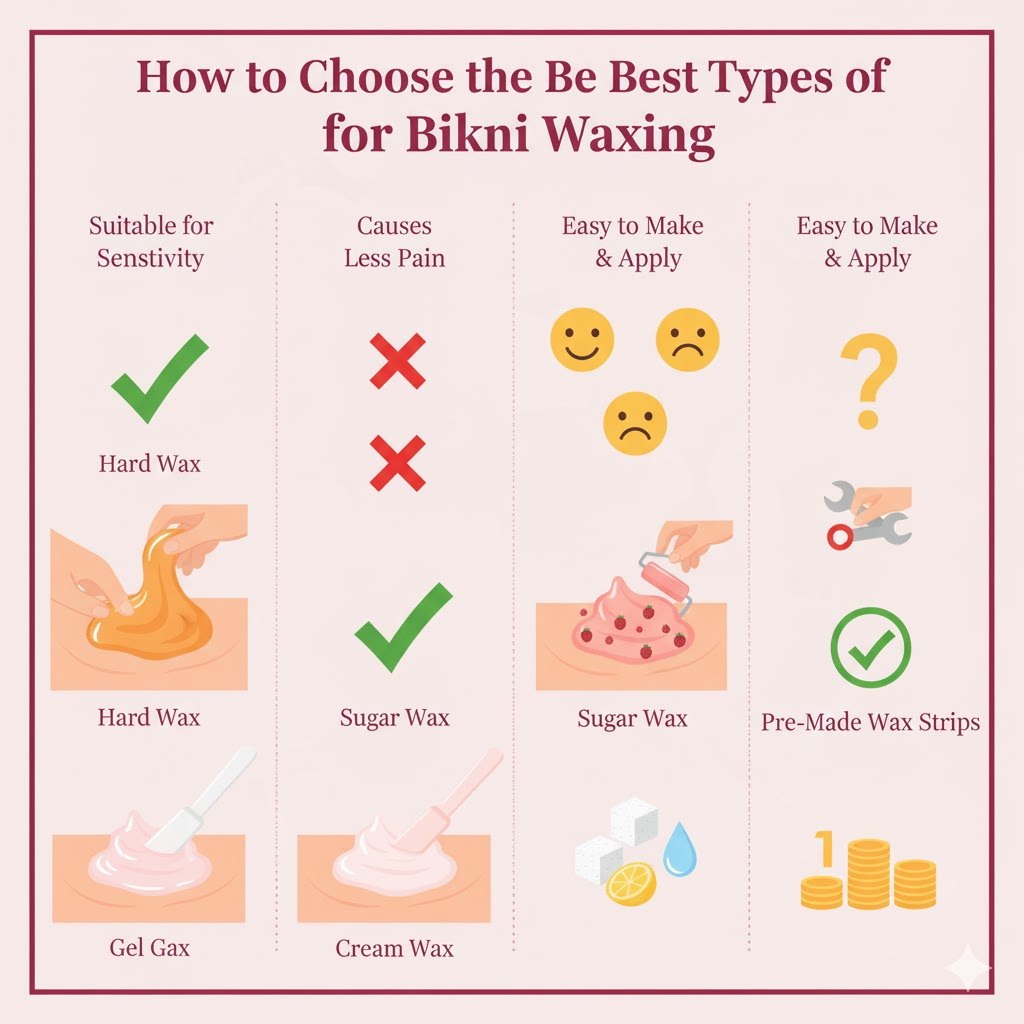
1. Choose a Wax Type That is Suitable for Sensitive Area
The bikini area is one of the most delicate parts of the body, with thinner skin and a higher concentration of nerve endings—making it more prone to irritation, redness, and small abrasions.
Using the wrong wax type or an incorrect temperature can easily cause burns, tug at the skin, or remove part of its protective outer layer, leading to discomfort and inflammation. That’s why extra care is essential when choosing a wax for this sensitive region.
The best choice is hard wax, as it adheres primarily to the hair rather than the skin. It sets gently, removes cleanly without the need for strips, and minimizes pulling, which reduces pain and lowers the risk of irritation or redness after waxing.
2. Choose a Wax Type That is Causes Less Pain
Pain is one of the main concerns during bikini waxing because the skin in this area is thin and highly sensitive. If the wax clings too tightly to the skin instead of the hair, it can cause sharp discomfort, redness, and even small tears.
A good wax selection minimizes skin pull and allows the hair to lift cleanly, while a poor choice—like one that’s too sticky or too hot—can lead to irritation and bruising.
For a smoother, more comfortable experience, the best option is hard wax. It adheres primarily to the hair rather than the skin, sets gently, and comes off cleanly without the need for strips, making it noticeably less painful compared to other types of wax.
3. Choose a Wax Type That is Easy to Make and Apply
When convenience is your main goal, the best wax is one that requires minimal effort to prepare and use while still giving smooth results. Complex heating or multi-step setups can lead to uneven application, burns, or wasted product. A good, easy-to-handle wax should melt or spread quickly, work at a safe temperature, and come off cleanly without extra tools.
The simplest option for this purpose is sugar wax. It’s made from just sugar, water, and lemon juice—common kitchen ingredients—and can be prepared at home in a few minutes. Once cooled to room temperature, it spreads easily on the skin, doesn’t require fabric strips if you use the thicker version, and rinses off simply with warm water.
This makes sugar wax both beginner-friendly and quick to apply, ideal for anyone looking for a low-effort bikini waxing option.
4. Choose a Wax Type That is Affordable
If you’re looking for an option that fits your budget while still giving smooth results, focus on wax types made from simple, natural ingredients or those that don’t require special tools. Expensive professional waxes or complex kits can increase costs without offering much added benefit for regular home use.
A good affordable wax should be easy to make, require minimal equipment, and still be gentle on the skin. The most cost-effective choice is sugar wax. It’s made from just sugar, water, and lemon juice—items you likely already have in your kitchen—so there’s no need to buy costly products or heating devices.
You can prepare it at home, use it at room temperature, and clean up easily with warm water. This makes sugar wax not only inexpensive but also practical and sustainable for regular bikini waxing.
Exploring the Different Types of Bikini Wax
Now that you’ve learned about the best types of wax for bikini waxing and how each one works, it’s time to understand the different styles and types of bikini waxing. Knowing the waxing style you prefer—whether a classic bikini line, full bikini, Brazilian, or Hollywood—helps you decide how much hair to remove and which method suits your comfort level best.
To explore these styles in detail and choose the one that matches your personal preference, read our next guide on types of bikini wax, where we break down each option clearly to help you make an informed choice.
Preparing for Your Bikini Wax
Now that you know the different types of wax for bikini waxing and types of bikini waxing as well and their unique benefits, it’s just as important to understand how to get your skin ready before the procedure. Proper preparation can make a huge difference—it helps minimize pain, prevents irritation, and ensures smoother results.
If you’re wondering what steps to take before your appointment, check out our detailed guide on “how do you prepare for a bikini wax”, where we walk you through everything for the preparation of the bikini waxing.
Conclusion
Finding the right wax for bikini waxing depends on your skin sensitivity, comfort level, and desired results.
Whether you prefer the gentleness of hard wax, the natural touch of sugar wax, or the nourishment of chocolate and fruit wax, understanding their differences helps you achieve smoother, irritation-free skin.
With the right selection and technique, bikini waxing can be both effective and comfortable, leaving you feeling confident and beautifully groomed.