
Published On: 08 September 2026
Choosing the right gel nail polish can be confusing when every formula promises strength, shine, flexibility or easy removal. But what actually separates one type from another, and which option suits your manicure needs?
This article explores the key types of gel nail polish, including hard gel, soft gel, builder gel, rubber gel and treatment gel. It also explains soak-off, one-step, peel-off, LED and UV gel polishes.
You will learn how each formula works, how it is cured, what kind of finish and durability it provides, and whether it is designed for overlays, extensions or added nail support.
We also cover important application and removal differences to help you understand each option before choosing your next gel manicure with confidence.
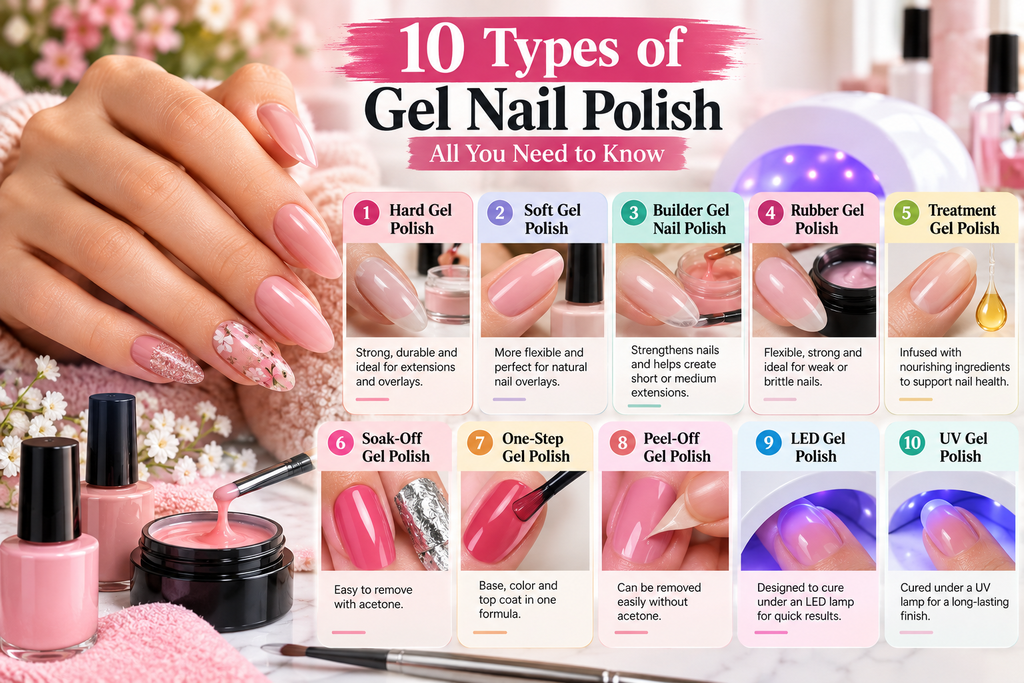
1. Hard Gel Polish
Among the different types of gel nail products available, hard gel is considered one of the strongest. As its name suggests, it creates a hard and durable coating. Hard gel contains cross-linking oligomers that form strong bonds when cured under an LED or UV lamp.
These bonds create a dense structure that solvents such as acetone cannot easily penetrate. For this reason, hard gel is difficult to soak off and is usually removed by filing.
According to a research article, hard-gel systems may offer a favourable safety profile because they contain higher-molecular-weight oligomeric matrices with a lower sensitising potential, provided that the gel is fully and properly cured.
Hard gel has several notable qualities: it is strong, flexible, odorless and self-levelling. These features make it a suitable option for beginners who want a smooth and long-lasting finish.
A hard-gel manicure can generally last for three to four weeks, after which a refill or maintenance appointment is usually required.
Because of its exceptional strength and durability, hard gel is commonly used to create gel nail extensions. It can also be applied as an overlay on natural nails to add structure, support and strength.
2. Soft Gel Polish
Soft gel polish is another type of gel nail product with a softer and more flexible structure. This flexibility comes from the plasticisers used in its formulation. Because soft gel moves naturally with the nail, it is commonly applied as an overlay on natural nails. However, it is generally unsuitable for creating long extensions because its softer structure may bend or break under additional length and weight.
According to research, soft gel is more flexible and is therefore particularly suitable for natural nail overlays.
When soft gel is applied as an overlay, it is cured under an LED or UV lamp. Once properly cured, it becomes strong and provides a durable, chip-resistant finish while retaining some flexibility.
Soft gel polish is classified as a soak-off gel and can usually be removed with acetone. However, acetone may temporarily dry out the nails and surrounding skin.
To reduce exposure, the gel’s top layer may first be filed gently before acetone is applied. The natural nail itself should not be aggressively filed, as this can cause thinning and damage. After removal, cuticle oil and a moisturiser should be applied to restore moisture to the nails and skin.
3. Builder Gel Nail Polish
Builder gel is a type of gel nail product designed for two main purposes: strengthening and extending the nails. It can be applied as an overlay on natural nails to provide additional strength and protection.
It may also be used to create short or medium-length extensions. However, builder gel is generally unsuitable for creating very long extensions because it may not provide sufficient strength to support the added length.
Like other gel nail products, builder gel is available in bottles and is usually applied with the built-in brush. Depending on its formulation, it may or may not be removable with acetone. Always read the manufacturer’s instructions to determine the correct removal method.
Soak-off builder gel can be removed with acetone, whereas file-off builder gel must be carefully filed away.
Builder gel in a bottle, often known as BIAB, usually contains additional ingredients that give it a thinner consistency and make it easier to apply. Builder gel supplied in a pot is generally more viscous and may provide greater strength and control during nail sculpting.
Another advantage of builder gel is that it feels relatively lightweight on the nail surface while still providing structure and support. Its self-levelling properties also help create a smooth, even surface with minimal filing or buffing.
4. Rubber Gel Nail Polish
Rubber gel polish is a type of gel nail product particularly suitable for weak, thin or damaged nails. For this reason, professional nail technicians often recommend it to clients whose nails require additional support or who experience adhesion problems.
During manicures and pedicures, rubber gel is generally used as a base coat. It provides a strong foundation and improves the adhesion of the gel polish or colour coat applied over it.
Rubber gel has a thicker and more flexible consistency than a traditional gel base coat. Its flexibility allows it to move naturally with the nail, reducing the risk of breakage. It also bonds firmly to the natural nail plate, which helps minimise cracking, chipping and lifting.
Another notable feature of rubber gel polish is that it is available in various neutral and natural-looking shades. These shades can complement a wide range of skin tones and may be worn alone for a clean, natural appearance or used as a base underneath another colour.
5. Treatment Gel Polish
Treatment gel is a type of gel nail product designed not only to create a polished appearance but also to protect and support natural nails. Some treatment gels contain conditioning ingredients such as vitamin E.
According to Medical News Today, vitamin E oil may support nail health by moisturising dry skin and helping to prevent cracked cuticles, although scientific evidence for many of its wider benefits remains limited.
Treatment gel can also help protect nails from common problems such as peeling, cracking and breakage. By adding a supportive layer over the natural nail, it helps reinforce weak or damaged areas.
Some treatment-gel and builder-gel formulations contain fibreglass or nylon fibres to improve strength and durability. These tiny fibres act like reinforcing patches that help hold the nail together and may prevent existing damage from worsening.
Another advantage of treatment gel is its flexibility. It moves naturally with the nail, reducing stress on the nail plate and lowering the risk of premature cracking or lifting. This flexibility may also help the manicure last longer.
6. Soak-Off Gel Polish
Soak-off gel polish is specifically designed for easy removal from the nails. Its formulation contains gel ingredients that provide strong adhesion and a long-lasting finish while allowing the coating to soften and dissolve when soaked in acetone.
It is commonly applied as an overlay on natural nails. Once cured under a UV or LED lamp, it creates a smooth, glossy and chip-resistant finish.
Its lightweight and flexible formulation feels comfortable on natural nails, making it suitable for everyday manicures. When correctly applied and maintained, soak-off gel polish can last for two weeks or longer.
The main advantage of soak-off gel polish is its convenient removal process. Unlike hard gel, which usually needs to be filed off, soak-off gel can be softened with acetone and gently removed.
This makes it an excellent choice for users who prefer a durable, glossy manicure with a relatively convenient removal process.
However, the correct removal technique must be followed to avoid damaging the natural nail plate. The polish should never be peeled, scraped or forcibly removed.
7. One-Step Gel Polish
One-step gel polish is designed for quick and simple application. Its formulation combines the properties of a base coat, colour coat and top coat in a single product, reducing the need to apply multiple separate layers.
It can be applied directly to natural nails and, once cured under a UV or LED lamp, creates a smooth, glossy and durable finish. Its straightforward application process makes it a suitable option for beginners and users who want to achieve a professional-looking manicure in less time.
The key advantage of one-step gel polish is its time-saving formula, as it generally does not require a separate base coat or top coat. It can provide good colour coverage, shine and resistance to chipping.
One-step gel polish is therefore a convenient choice for those who prefer easy application, quick curing and a low-maintenance gel manicure.
However, application instructions may vary between brands, so users should always follow the manufacturer’s recommended preparation, curing and removal guidelines.
8. Peel-Off Gel Polish
Peel-off gel polish is specifically designed for easy removal. Its formulation creates a coloured layer over the nail surface that can be peeled away after wear. It is a convenient option for users who want to change their gel manicure without using acetone or following a lengthy removal process.
Peel-off gel polish can be applied to natural nails and, depending on the product, may require curing under a UV or LED lamp.
Once cured, it provides a smooth and glossy finish. Its quick application and simple removal process make it particularly suitable for beginners, frequent colour changes and temporary nail looks.
However, peel-off gel polish may be less durable than traditional gel polish because of its easy-removal formula. It should never be pulled or removed forcefully, as this could strip away layers of the natural nail plate.
Always follow the manufacturer’s instructions and use a gentle removal technique to minimise the risk of nail damage.
9. LED Gel Polish
LED gel polish is formulated to cure under an LED nail lamp. It contains photoinitiators that absorb compatible wavelengths of LED light and trigger a chemical reaction, transforming the liquid gel into a hard and durable coating.
LED gel polish can be applied to natural nails and produces a smooth, glossy and chip-resistant finish after curing. One of its main advantages is its fast curing time, as compatible LED lamps generally cure gel polish more quickly than traditional UV lamps.
This type of gel polish can provide vibrant colour, lasting shine and a durable finish. It is suitable for users who prefer quick application, professional-looking results and a long-lasting manicure.
However, the gel polish and lamp must be compatible to ensure complete curing. The manufacturer’s instructions should always be followed for application, curing time and removal to minimise the risk of skin irritation or damage to the natural nails.
10. UV Gel Polish
UV gel polish is formulated to cure when exposed to ultraviolet light. According to research, gel nail products contain photoinitiators that absorb light energy and initiate polymerisation.
This chemical reaction transforms the liquid gel into a hard, durable and long-lasting coating.
UV gel polish can be applied to natural nails and, once cured under a compatible UV lamp, creates a smooth, glossy and chip-resistant finish.
Its strong adhesion and professional appearance make it suitable for both salon and at-home manicures.
Its durability, shine and resistance to chipping distinguish UV gel polish from traditional air-dried nail polish. It is a suitable option for users who prefer lasting colour, a smooth appearance and a salon-quality manicure.
The correct removal method depends on the product’s formulation. Soak-off UV gel can be softened with acetone, whereas file-off formulas must be carefully filed away.
The manufacturer’s application, curing and removal instructions should always be followed to minimise the risk of skin irritation or damage to the natural nails.
Learn About Benefits of Gel Nail Polish
Gel nail polish offers several benefits that make it a popular choice for a long-lasting manicure. Its durable finish helps reduce chipping, while the high-shine appearance keeps nails looking polished and fresh.
Gel polish also provides quick curing and can maintain its smooth finish for an extended period. Want to understand these benefits in more detail?
Explore our complete guide on the benefits of gel nail polish to discover why these features make gel polish a popular choice.
How to Apply Gel Nail Polish
Applying gel nail polish involves a few simple steps to achieve a smooth, long-lasting finish. The process typically includes preparing the nails, applying thin layers of gel polish, and curing each layer under a UV or LED lamp.
Want to learn how to achieve a neat and professional-looking result? Read our detailed guide on How to Apply Gel Nail Polish for a clear overview of the process and the steps involved.
Conclusion
Gel nail polish is available in several formulations, each designed for different manicure needs. Hard and builder gels provide strength and support, while soft, rubber and treatment gels offer flexibility or reinforcement for natural nails.
Soak-off and peel-off formulas focus on easier removal, whereas one-step gel simplifies application by combining several product functions.
LED and UV gels are distinguished by their compatible curing methods and photoinitiators. Understanding these differences can help you select a gel based on durability, application time, nail condition, desired length and removal process.
Whichever option you choose, always follow the manufacturer’s instructions for preparation, curing and removal to protect your natural nails and achieve suitable results.