
Published On: 19 Jan 2026
Choosing between sugar wax and hard wax can be confusing, especially when both methods promise smooth, long-lasting results. Each technique differs in ingredients, application, pain level, suitability for skin and hair types, cost, and performance across body areas.
This article breaks down sugar wax vs hard wax through clear, side-by-side comparisons based on real use cases, research-backed insights, and practical factors that actually matter.
You should read this full article if you want to understand which method lasts longer, hurts less, reduces ingrown hairs, suits sensitive skin, works better for Brazilian or bikini waxing, and fits your budget. By the end, you’ll be able to confidently choose the waxing method that best matches your skin, hair, and comfort needs.
What Is Sugar Wax
Sugar wax is a natural hair removal method that uses a sugar paste made from simple ingredients such as sugar, water, and lemon juice. Unlike traditional waxes, sugar wax is not resin-based and does not contain synthetic chemicals, which makes it a gentler option for many skin types. The paste is applied against the direction of hair growth and removed in the direction of growth, helping pull hair out from the root while reducing breakage and irritation.
According to market research, the global sugaring hair removal market was valued at USD 2.61 billion in 2023. It is projected to increase from USD 2.74 billion in 2024 to USD 4.12 billion by 2032, growing at a compound annual growth rate (CAGR) of 5.21% throughout the forecast period.
What is Hard Wax
Hard wax is a popular type of hair removal wax that contains glyceryl rosinate, beeswax, rosin, ethylene/VA copolymer, lanolin, triethanolamine, hydroabietyl alcohol, and cosmetic colorants. These ingredients help the wax melt evenly, spread smoothly, and ensure clean, effective hair removal. Hard wax is applied in the direction of hair growth while removed against the direction of hair growth.
According to research, the global hard wax market is projected to reach USD 1.5 billion by 2033, driven by a compound annual growth rate (CAGR) of 6.2% from 2025 to 2033.
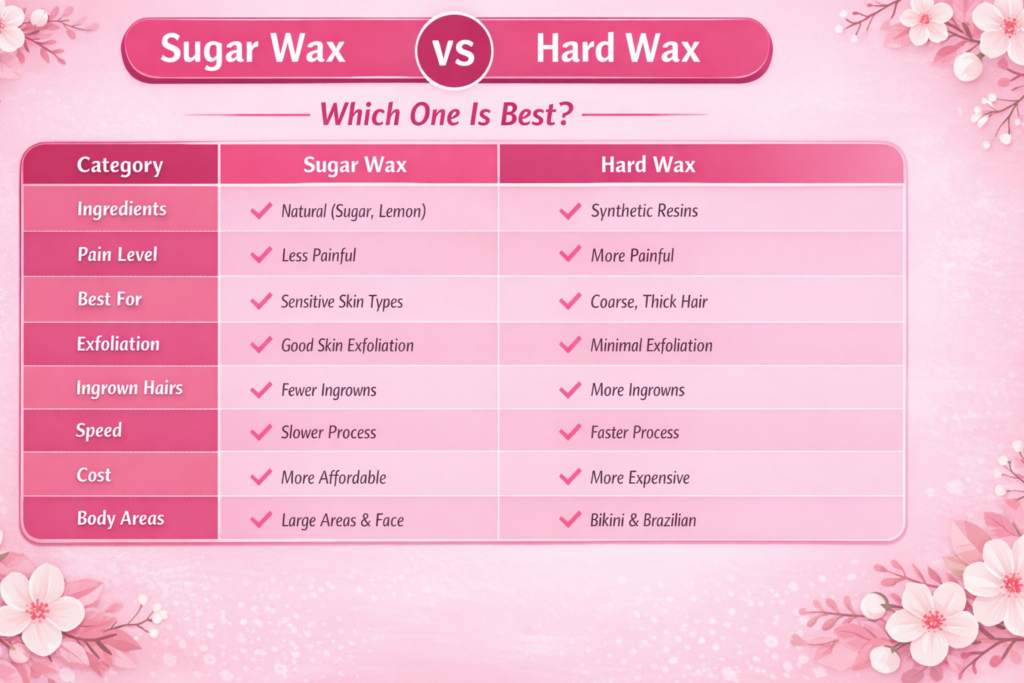
Sugar Wax Vs Hard Wax | A Quick Comparison
| Feature | Sugar Wax | Hard Wax |
|---|---|---|
| Ingredients | Natural (sugar, lemon, water) | Resin-based, synthetic blends |
| Application Temperature | Room or body temperature | Heated (125–140°F) |
| Removal Direction | With hair growth | Against hair growth |
| Pain Level | Less painful | Moderate pain |
| Exfoliation | Removes dead skin cells | Minimal exfoliation |
| Ingrown Hairs | Fewer ingrown hairs | Higher ingrown risk |
| Hair Regrowth | Slower, finer regrowth | Normal regrowth |
| Best for Skin Types | Sensitive & reactive skin | Normal skin |
| Best for Hair Types | Fine to medium hair | Coarse, thick hair |
| Best Body Areas | Legs, arms, face, bikini | Bikini, Brazilian, underarms |
| Time Required | Slower process | Faster process |
| Cleanup | Easy, water-soluble | Requires oil cleanup |
| Beginner Friendly | Yes | Moderate |
| Environment Friendly | Highly eco-friendly | Less eco-friendly |
| Cost | More affordable | More expensive |
| Brazilian Waxing | Gentle, multiple passes | Efficient, fewer passes |
| Bikini Waxing | Sensitive skin option | Best for coarse hair |
| Blackhead Removal | Helps exfoliate pores | Not effective |
How to Apply Sugar Wax
To apply sugar wax, start by thoroughly cleansing the area to remove oil, sweat, or product buildup, then lightly dust the skin with powder to absorb moisture. Scoop a small amount of sugar paste and apply it against the direction of hair growth using firm, controlled pressure so the paste can grip the hair properly.
Allow the paste to settle for a moment, but do not let it fully harden. Remove the sugar wax in the direction of hair growth, either by flicking it off by hand or using strips, depending on the paste type. Sugar wax is applied at room or body temperature, making it gentle and safe for the skin.
How to Apply Hard Wax
To apply hard wax, begin by cleansing the skin and applying a light layer of powder to ensure the wax adheres to the hair, not the skin. Heat the hard wax to the recommended temperature of about 125–140°F until it reaches a thick, honey-like consistency.
Using a spatula, apply the wax in the direction of hair growth with firm pressure, creating a slightly thicker edge for easy removal. Allow the wax to cool and fully harden. Once set, hold the skin taut and remove the wax quickly against the direction of hair growth, without using strips.
Which Lasts Longer: Sugar Waxing or Hard Wax?
Sugar waxing and hard wax both remove hair from the root, so their results are generally similar in duration, typically lasting 3 to 5 weeks. However, for many people, sugar waxing tends to last slightly longer.
The main reason lies in the removal technique. Sugar wax is applied against hair growth and removed in the direction of growth, which reduces hair breakage and allows the hair to be extracted more cleanly from the follicle.
In contrast, hard wax is usually removed against hair growth, which can sometimes cause hair to snap instead of being fully pulled out. Individual’s hair growth cycle, hair thickness, skin type, and aftercare also influence longevity.
Supporting this, a 2022 study on the effectiveness of sugaring found that hair regrowth after sugaring was slower, finer, and less dense over four weeks compared to hard waxing, suggesting longer-lasting smoothness.
Which Offers Better Exfoliation: Sugar Wax vs Hard Wax
Sugar wax offers better exfoliation compared to hard wax because of how it interacts with the skin during removal. Sugar wax is made from natural, water-soluble ingredients that gently adhere not only to the hair but also to dead skin cells on the surface.
When the paste is removed, it lifts away these dead cells along with the hair, providing a mild exfoliating effect that leaves the skin smoother and brighter. This dual action helps unclog pores and improve overall skin texture over time.
Hard wax, on the other hand, is designed to grip hair while minimizing contact with the skin. While this makes it gentler for sensitive areas, it also means hard wax does not remove dead skin cells as effectively. As a result, sugar waxing delivers more noticeable exfoliation than hard waxing.
Which Takes Less Time: Sugar Wax or Hard Wax
Hard wax generally takes less time than sugar wax, especially when treating defined sections of the body. Hard wax is applied to one section at a time, allowed to set, and then removed in a single, clean pull. Because it hardens around the hair rather than spreading thinly across the skin, it lifts off cleanly.
Research also states that hard waxing leaves little to no residue behind, which reduces cleanup time. This efficient process allows practitioners to move quickly from one section to the next without repeating applications.
Sugar wax, by contrast, often requires multiple flicking motions and reapplication on the same area to achieve complete hair removal. While any leftover residue can be easily washed away with water, the repeated application can slow the process. For those who prefer a faster, more direct waxing session, hard wax is usually the quicker option.
Which Causes Less Pain: Sugar Wax vs Hard Wax
Pain during waxing depends on several key factors, including how strongly the wax adheres, the direction of hair removal, and the ingredients used in the formula.
When comparing sugar wax and hard wax, sugar waxing is generally considered less painful for most people. One major reason is removal technique. Sugar wax is removed in the direction of hair growth, which reduces resistance at the follicle, making the pull feel gentler. Hard wax, however, is removed against hair growth, which can create more tension at the root and increase discomfort.
Ingredients also play a role. Sugar wax contains natural components that are less likely to cause irritation, while hard wax may include resins or chemical additives that can trigger sensitivity in some skin types.
Since both mainly adhere to hair rather than skin, pain remains relatively low due to this factor, but sugar wax is usually more comfortable overall.
Which Causes Fewer Ingrown Hairs: Sugar Wax vs Hard Wax
Sugar waxing generally causes fewer ingrown hairs than hard wax, although no hair removal method can eliminate them completely. The main reason is the direction of removal. Sugar wax is applied against hair growth and removed in the direction of growth, which reduces hair shaft breakage and minimizes trauma to the follicle.
Research supports that hair removal in the direction of growth leads to fewer ingrown hairs because the hair is pulled out cleanly from the root instead of snapping below the skin’s surface.
Hard wax can still remove hair effectively, but because it is pulled against hair growth, breakage is more likely. As a result, sugar waxing is the better option for preventing ingrown hairs.
Which Reduce the Hair Regrowth Effectively: Sugar Wax vs Hard Wax
Both sugar waxing and hard wax remove hair from the root, so they are more effective at slowing regrowth than shaving. However, sugar waxing tends to reduce hair regrowth more effectively over time. The reason lies in how the hair is removed. Sugar wax is taken off in the direction of hair growth, which reduces breakage and allows the entire hair to be pulled cleanly from the follicle. This complete removal weakens the hair over repeated sessions, leading to finer and slower regrowth.
This difference is supported by a 2022 study titled “A Study on the Waxing Effectiveness of Sugaring,” which found that hair regrowth after sugaring was slower, thinner, and less dense over a four-week period compared to hard waxing.
These findings confirm that sugaring provides longer-lasting and more effective regrowth reduction when performed consistently.
Which Is Best for Different Body Areas: Sugar Wax vs Hard Wax
Sugar wax is a versatile option that works well on almost all body areas, including large areas like the legs, arms, and back, as well as smaller and more sensitive zones such as the eyebrows, upper lip, underarms, bikini line, and Brazilian area. Because sugar wax is made from natural ingredients and adheres mainly to hair and dead skin rather than live skin and It is also cost-effective for full-body use.
Hard wax, on the other hand, is best suited for small, sensitive areas like the face, underarms, and bikini line. While it is gentle, using hard wax on large areas can be time-consuming and costly.
Which Is Best for Different Skin Types: Sugar Wax vs Hard Wax
The best waxing method often depends on your skin type, whether it is normal, sensitive, or reactive. For normal skin, hard wax works well because the skin can usually tolerate resin-based formulas and removal against the direction of hair growth without excessive irritation. Hard wax grips the hair effectively and provides clean results when the skin barrier is strong.
However, for sensitive or reactive skin, sugar wax is the better choice. Sugar wax is made from natural ingredients and is less likely to trigger irritation, itching, or redness. It adheres mainly to the hair rather than the skin and is removed in the direction of hair growth, which reduces stress on the skin. This gentle technique makes sugar waxing safer and more comfortable for delicate and easily irritated skin types.
Which Is Best for Different Hair Types: Hard Wax Vs Sugar Wax Wax
Choosing between sugar wax and hard wax largely depends on the thickness and texture of your hair. For fine to medium hair, sugar wax works beautifully. The sugar paste is able to grip finer strands effectively and remove them cleanly from the root without excessive pulling. Because it is removed in the direction of hair growth, it reduces breakage and is gentle on the skin, making it ideal for lighter hair types and regular maintenance.
For coarse or short hair, hard wax is the better option. Hard wax is applied warm and shrink-wraps tightly around thick or stubborn hairs as it cools. This strong grip allows it to remove coarse and short hair more efficiently, even in dense areas. For these hair types, hard wax delivers more reliable and thorough results.
Which Is Best for Beginners: Sugar Wax or Hard Wax
For beginners, sugar wax is generally the better choice because it is easier to use and more forgiving for first-time users. Sugar wax is made from natural ingredients, which makes it gentler on the skin and less likely to cause irritation or allergic reactions. It is applied at room or body temperature, reducing the risk of burns, and it is easy to control during application.
Sugar wax is also removed in the direction of hair growth, which helps minimize pain and lowers the chances of ingrown hairs. Another advantage for beginners is that sugar wax is water-soluble, so any mistakes or residue can be cleaned up easily with water. These qualities make sugar waxing a safer, more comfortable, and beginner-friendly hair removal option.
Which Is Environment Friendly: Hard Wax Vs Sugar Wax
Sugar wax is the more environmentally friendly option when compared to hard wax. It is made from natural, biodegradable ingredients such as sugar, lemon juice, and water, which break down easily without harming the environment. Sugar waxing often requires fewer disposable materials, as it can be removed by hand or with reusable strips, and any residue can be cleaned with water instead of chemical removers. This reduces waste and chemical use.
Hard wax, while effective, is usually made with resins, synthetic polymers, and other processed ingredients that are not always biodegradable. It also requires heating devices that consume electricity and generate more product waste, especially in professional settings. Because of its natural composition and lower environmental impact, sugar wax is the more eco-friendly hair removal choice.
Which Is Best During Periods: Sugar Wax vs Hard Wax
During periods, the skin becomes more sensitive due to hormonal changes, which means any hair removal method can feel more painful than usual. If we remove the period factor, sugar wax is already considered more skin-friendly because it causes less pain and fewer ingrown hairs.
When periods are taken into account, both sugar wax and hard wax can cause discomfort, as heightened skin sensitivity makes the skin react more strongly.
However, sugar wax still remains the better option during this time. Because it is removed in the direction of hair growth and adheres mainly to hair rather than skin, it creates less pulling and irritation. Its natural ingredients also reduce the risk of itching or inflammation.
While waxing during periods may never be completely pain-free, sugar waxing is generally the less painful and safer choice.
Which Is Best In Pregnancy: Sugar Wax vs Hard Wax
During pregnancy, hormonal changes often make the skin more sensitive, which can increase pain, redness, and irritation during hair removal. In this situation, sugar wax is generally the better choice compared to hard wax. Sugar wax is made from natural ingredients and does not contain harsh chemicals, making it safer and gentler for sensitive, pregnancy-affected skin.
It is applied at room or body temperature, reducing the risk of burns, and removed in the direction of hair growth, which helps minimize pulling and discomfort. Hard wax, although effective, is applied hot and removed against hair growth, which can feel more painful when skin sensitivity is already heightened.
While both methods are considered safe during pregnancy, sugar waxing is usually more comfortable and better tolerated, making it the preferred option for expecting mothers.
Which Is More Affordable: Hard Wax Vs Sugar Wax
Sugar wax is generally more affordable than hard wax, especially for regular or full-body use. It is made from simple, inexpensive ingredients such as sugar, water, and lemon juice, which keeps both professional and at-home costs low. Sugar wax can also be reused on the same section during a session, reducing product waste.
Hard wax is usually more expensive because it is made with resins and specialized formulations and requires heating equipment to maintain the correct temperature. It is also used in thicker layers, which increases product consumption. For budget-conscious users, sugar waxing is the more cost-effective option.
Which Is Better for Brazilian Waxing: Hard Wax Vs Sugar Wax
When comparing sugar wax and hard wax for Brazilian waxing, hard wax is generally the better option for most people, especially those with coarse or dense hair. Brazilian hair is typically thicker and more stubborn, and hard wax provides a stronger grip, allowing it to remove hair effectively in fewer passes. Because hard wax adheres mainly to the hair and not the skin, it still offers a relatively gentle experience in this sensitive area while delivering efficient results in one pull.
Sugar wax, while more natural and less irritating, often requires multiple passes to fully remove coarse Brazilian hair, which can increase overall discomfort despite its gentler nature. For individuals with extremely sensitive skin, sugar wax may feel more comfortable, but in terms of efficiency, speed, and complete hair removal, hard wax is usually the preferred choice for Brazilian waxing.
Which Is Better for Bikini Waxing: Sugar Wax vs Hard Wax
When comparing sugar wax and hard wax for bikini waxing, hard wax is generally the better option for most people, especially those with coarse or dense hair along the bikini line. Hard wax shrink-wraps tightly around the hair and lifts it with minimal skin contact, which allows effective removal in fewer passes and reduces repeated pulling on this sensitive area. This efficiency often makes the process quicker and more reliable for thicker hair.
Sugar wax, on the other hand, is a gentler and more natural alternative that adheres only to hair and not the skin. This makes it a good choice for individuals with highly sensitive skin or a tendency toward irritation and ingrown hairs. However, because sugar wax is less sticky, it may require multiple passes to fully remove coarse bikini hair. Overall, hard wax is preferred for efficiency, while sugar wax suits those prioritizing sensitivity and natural ingredients.
Which Is Helpful in Better Removing Black Heads: Hard Wax Vs Sugar Wax
Between sugar wax and hard wax, sugar wax is more helpful for removing blackheads, though neither method is a permanent solution. Sugar wax adheres to dead skin cells, excess oil, and surface debris along with fine hair. When removed, it gently exfoliates the skin and can lift the oxidized tops of blackheads, making pores appear cleaner and smoother. This exfoliating action helps temporarily clear clogged pores.
Hard wax, however, is designed to grip hair only and does not attach to skin debris or oil inside pores. As a result, it is not effective for blackhead removal. While sugar waxing can improve skin appearance short term, proper exfoliation and skincare are still required for long-term blackhead control.
Sugar Wax – Pros
- Natural skin-safe ingredients
- Less pain overall
- Fewer ingrown hairs
- Gentle surface exfoliation
- Easy water cleanup
Sugar Wax – Cons
- Multiple passes needed
- Less grip coarse
Hard Wax – Pros
- Strong coarse hair grip
- Fewer application passes
- Ideal sensitive areas
- No strip required
- Clean residue removal
Hard Wax – Cons
- Higher product cost
- Burn risk overheating
Conclusion
Both sugar wax and hard wax are effective hair removal methods, but the best choice depends on your individual needs. Sugar wax stands out for its natural ingredients, gentler application, lower pain levels, and reduced risk of ingrown hairs, making it ideal for sensitive skin, beginners, and full-body waxing.
Hard wax, on the other hand, offers stronger grip and faster results for coarse hair and smaller, sensitive areas like the bikini and Brazilian zones. By considering factors such as skin type, hair texture, pain tolerance, and budget, you can choose the waxing method that delivers the most comfortable and satisfying results for you.